The Arms Race Illusion: Why the US and China Are Developing AI Differently
Global AI investment will reach $700 billion this year, yet experts say the term "arms race" between the US and China is misleading. Washington is betting on scaling language models and reaching AGI, which suits the country's service-driven economy. Beijing, by contrast, uses AI as a productivity engine in the real economy: from robot-run "dark factories" to automated medicine and agriculture. This specialization reflects different economic landscapes. Specialists warn that blind competition for leadership can lead to safety protocols being ignored and to global risks, and they say countries need to find compromises on regulation.
AI-processed from IEEE Spectrum AI; edited by Hamidun News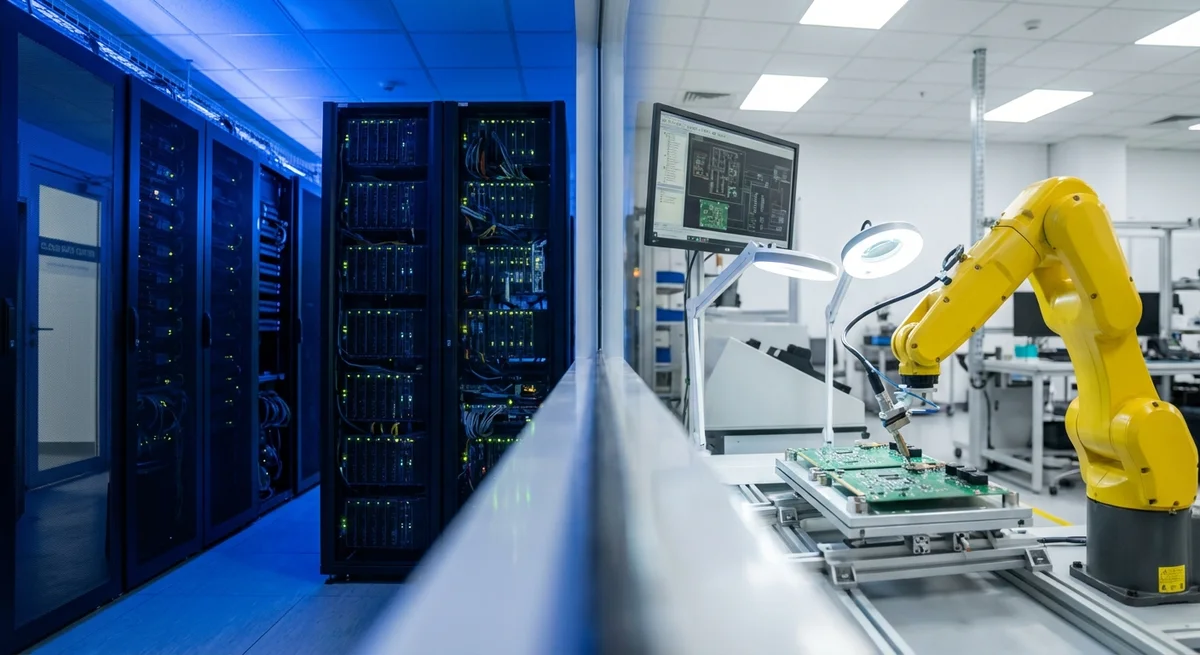
Global investment in artificial intelligence will pass the $700 billion mark this year, nearly double the figure from a year earlier. For comparison, the American Moon program cost less. But behind these numbers lies something more important than sheer scale: what politicians and journalists have grown used to calling an "arms race" between the US and China increasingly looks like an illusion, an appealing narrative that has little to do with reality.
The arms race metaphor did not appear by chance. Back in the 2010s, when machine learning moved to the forefront, figures such as Stephen Hawking and Elon Musk warned of the inevitable fusion of AI with military and economic power. The Cold War supplied a ready-made template for thinking about technological competition, and the media readily used it. Major labs, venture investors and analysts want simple, measurable indicators: model size, benchmark results, computing power. That is convenient, easy to grasp and sells well. But it is not true.
"The US and China are running on completely different tracks," says Selina Xu, who leads research on Chinese and AI policy on the team of Eric Schmidt, the former CEO of Google. Washington is betting on scaling language models in pursuit of AGI, artificial general intelligence that could surpass humans at any cognitive task. That strategy fits naturally with the structure of the American economy: services, finance, media, legal services and tech companies are where powerful generative models deliver immediate, tangible results.
Beijing is moving in a fundamentally different direction: it treats AI first and foremost as a tool for raising productivity in the real economy. "Dark factories," fully automated plants without a single worker, robotic logistics, and AI in medical diagnostics and agriculture are China's priorities. After decades of rapid growth, the country has built up a colossal industrial sector, and automating it is becoming the main driver of the national strategy.
The difference in goals exposes a fundamental contradiction in the very idea of a "finish line." If AGI is the ultimate goal of the race, a paradox arises, one that Graham Webster of Stanford University points to: machine intelligence that surpasses humans is, by definition, beyond the control of whoever created it. "Even if superintelligence emerges in a particular country, there is no guarantee that this country will get the benefits it was counting on," the researcher warns. In other words, "winning" this race may turn out to be the most dangerous outcome of all.
But the real threat of the "arms race" narrative is not metaphysical but entirely practical. Carson Ezell of the Institute for AI Policy and Strategy puts it bluntly: an arms race can become a self-fulfilling prophecy. When companies and governments adopt a "win at any cost" logic, safety concerns and ethical constraints start to look like ballast, dead weight that slows progress. Testing protocols get shortened. Oversight mechanisms get bypassed. The risk of systemic failures grows. And this is no longer a theoretical danger: the same dynamic played out in the history of nuclear and biological weapons.
Reality is more complicated and more interesting than any military analogy. The US and China are not rivals on the same track. They are building different infrastructure for different economic needs, and there is a logic to that. The problem arises when foreign policy and corporate strategy start to be shaped by a false map. Decisions made on the basis of an illusory symmetry of threats lead to real and asymmetric consequences.
The real challenge of our time is not to outrun the opponent but to work out common rules of the game before the stakes become too high. The history of technological revolutions has plenty of cases where countries that saw themselves as rivals ended up hostage to the same risks. In this sense, artificial intelligence is no exception: it only accelerates and sharpens a familiar dilemma between speed and caution, between national interests and global responsibility.
- Nov 2, 2026Karpathy builds a YouTube clone with 6454 videos from Hacker News recommendations in two hours
- Nov 2, 2026Karpathy used Claude to build HackerTube from 6,454 videos recommended on Hacker News
- Nov 2, 2026Anthropic needs to grow revenue 32% a year to cover $850 billion in contracts
- Nov 2, 2026Bun creator uses Claude Code to port 750K lines from Zig to Rust in 11 days
Test Frontier LLMs & Autonomous Agents in One Workspace
Run Claude Opus 5.5, GPT-6, Gemini 3.1, and DeepSeek side-by-side in Nomad AI (nomadnet.ai) — unified model routing, deep research, and multimodal workflows under one subscription.
The AI world, distilled — once a week
Seven stories that actually mattered, hand-picked. No noise, no reposts, no press releases.
Done! Check your inbox for a confirmation.