Meta is developing its own chips to train AI models
Meta Platforms is continuing its in-house chip program despite recent big deals with leading semiconductor makers. The company's chief financial officer confirmed plans to build processors that can do more than run future AI models: they would train them. That is a fundamentally higher level of ambition, since Meta's custom chips have so far focused mainly on inference. A move to training processors could shift the balance of power in the AI infrastructure market and reduce the company's dependence on NVIDIA. *Meta is designated an extremist organization and banned in Russia.
AI-processed from Bloomberg Tech; edited by Hamidun News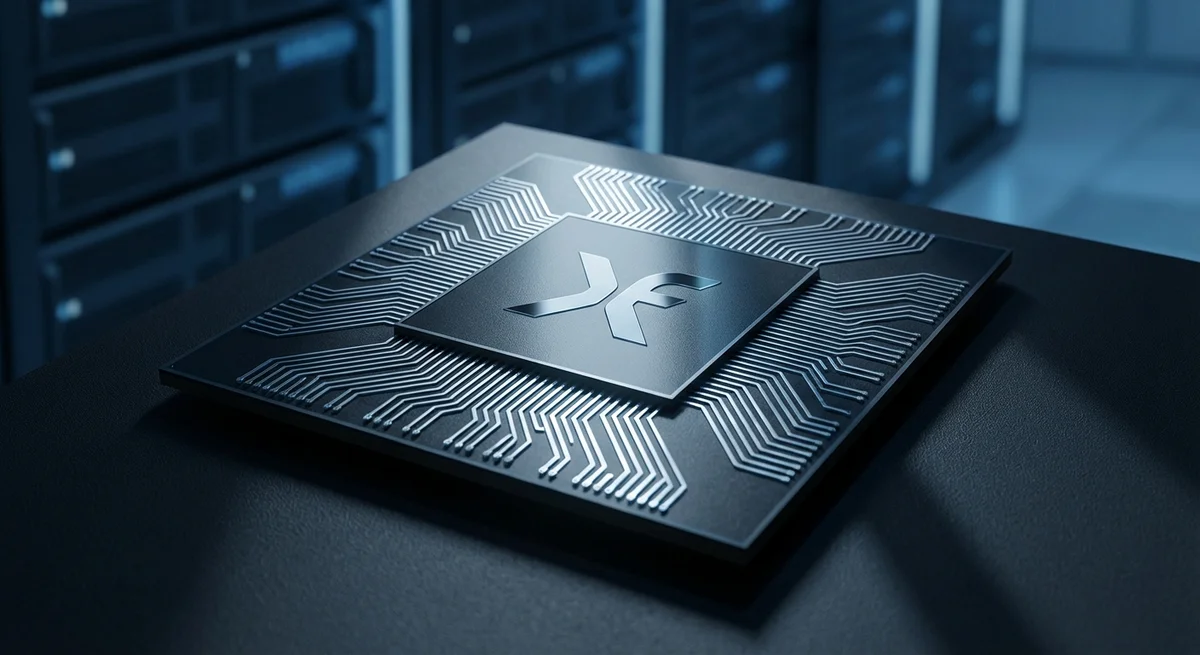
A company that spends tens of billions of dollars a year on artificial intelligence infrastructure no longer wants to depend on other people's processors, even at the most critical stage: training models. Meta Platforms' chief financial officer confirmed that the company is developing its own chips for training future AI models. The statement came on the heels of recently signed major contracts with leading semiconductor makers, and it signals that Meta's computing infrastructure strategy is becoming significantly more ambitious.
To grasp the scale of this step, some context helps. So far, Meta's custom chips, above all the MTIA family, have targeted inference, meaning running models that are already trained. Inference is the easier task: the model already knows what to do and only has to produce results quickly and efficiently. Training is a different beast entirely. Training a large language model demands enormous computing power, intricate coordination across thousands of processors and exceptional memory bandwidth. That is why NVIDIA, with its H100 and B200 GPUs, remains a virtually alternative-free supplier for this stage. Announcing a homegrown training chip means challenging that monopoly.
Meta's motivation is fairly transparent and can be measured in hard numbers. In 2025 the company spent roughly $35-40 billion in capital expenditure, mostly tied to AI infrastructure. A significant share of that went to buying GPUs from NVIDIA. At this scale, even a modest reduction in reliance on an outside supplier can save billions. But it isn't only about money. Custom chips let a company optimize the architecture for specific needs: for the architecture of LLaMA models, for the specifics of distributed training in Meta's data centers, for unique workload patterns. NVIDIA's general-purpose GPUs are excellent, but they are general-purpose by definition, and that inevitably means compromises.
Notably, the statement came after Meta struck major deals with leading chipmakers. Why invest in in-house development if partnerships with Broadcom, TSMC and other players already provide access to cutting-edge technology? The answer lies in the strategic planning horizon. Developing a training chip from scratch takes three to five years from concept to mass production. Meta is playing the long game: current contracts cover today's needs, while its own silicon is meant to secure independence in the next decade. It is the same logic followed by Google with TPU, Amazon with Trainium and Microsoft with Maia: the largest consumers of computing power cannot afford strategic dependence on a single supplier.
Still, the road from ambition to a working training chip is littered with technical and organizational difficulties. It took Google almost a decade to bring the TPU to the point where the company could train its largest models mainly on its own hardware. Amazon, despite significant investment in Trainium, still faces questions about its software ecosystem and compatibility. Building the chip is only half the job. You have to assemble the full stack: compilers, frameworks, debugging tools, monitoring systems. You have to persuade your own researchers, used to CUDA and PyTorch, to move to a new platform. And you have to ensure reliability across thousands of chips running together for months without failures.
For NVIDIA, the statement is one more worrying signal in a long series. Every major customer that announces its own chip program potentially shrinks the addressable market of Jensen Huang's company. Experience shows, however, that real replacement happens slowly. Even Google, which has the most mature custom AI chips in the industry, continues to buy GPUs from NVIDIA for certain workloads. Meta most likely is heading toward a hybrid model in which its own chips gradually take on a growing share of the load, while purchases from third-party suppliers remain as insurance and a complement.
Meta's decision to develop training chips is not just corporate news but an indicator of a fundamental shift in the industry. The era when a single supplier could control the computing foundation of the entire AI revolution is coming to an end. The world's largest technology companies are steadily building vertical integration, from models and data to the very silicon everything runs on. The question is no longer whether Meta can build a competitive training chip, but how fast it can do so, and how that will redraw the map of the multibillion-dollar AI infrastructure market.
*Meta is designated an extremist organization and banned in Russia.
- Nov 2, 2026Meta's Muse assistant keeps dossiers on loved ones and gets root on Ubuntu by default
- Nov 2, 2026The Verge reviewer builds a $50 Meta Muse Charm alternative with Claude Code
- Nov 1, 2026MoneyGate safety layer blocked all 42 fraudulent requests to local AI models
- Oct 31, 2026Open-source LLM gateway KTMS 1.0 plugs your own GPUs into the cloud and survives outages
Ship AI Faster with Founders, Engineers & Weekly Architecture Reviews
Inside Vibe Club (hamidun.com/club) — weekly live masterminds with Zhemal Khamidun, Tech Radar, full LMS access, and 370+ production Claude Code skills.
The AI world, distilled — once a week
Seven stories that actually mattered, hand-picked. No noise, no reposts, no press releases.
Done! Check your inbox for a confirmation.