Sandbar raises $23M for an AI ring
Sandbar has raised $23M in a Series A round to launch its Stream device this summer. The company is betting on a wearable format: the smart ring is meant to handle notes, conversations with an AI assistant and media playback. The deal shows that investor interest in compact AI devices persists, particularly in the segment of new interfaces beyond the smartphone. For Sandbar, the next test is not just the launch itself, but how easily users can fit such a device into their everyday routines.
AI-processed from TechCrunch; edited by Hamidun News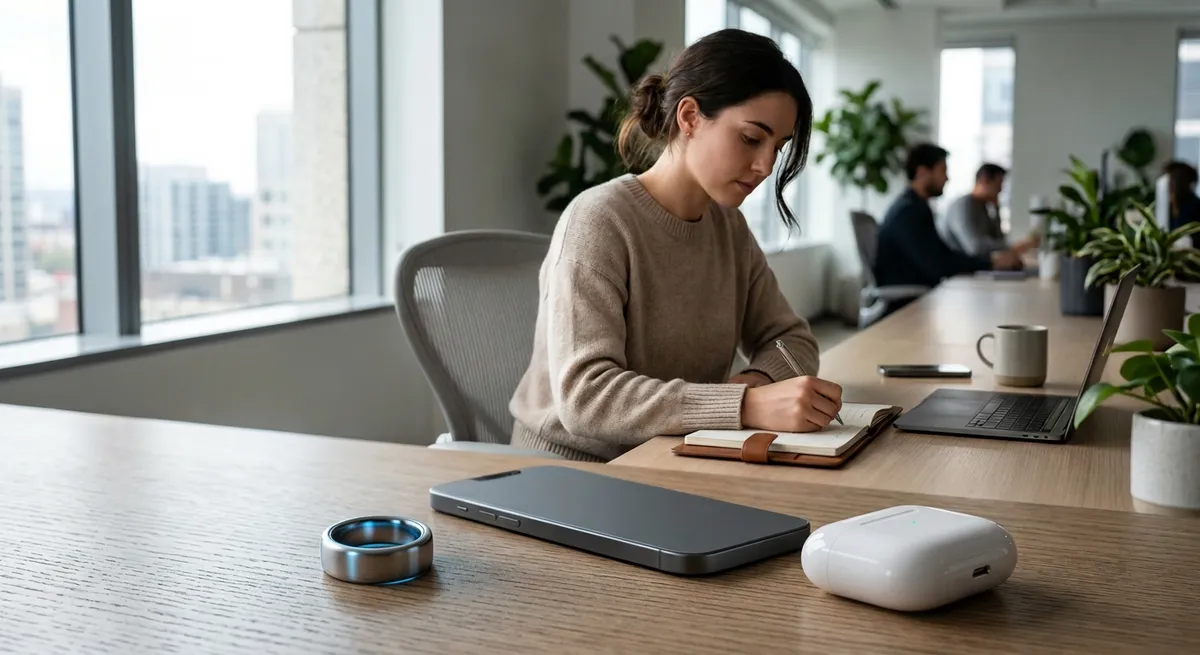
Sandbar raises $23M for an AI ring
The market for personal AI devices has lived through both a wave of enthusiasm and the first bouts of skepticism over the past year. Now it has a new signal from investors: startup Sandbar has closed a $23M Series A round and plans to launch Stream this summer, a smart ring for taking notes, talking to an AI assistant and playing media. At first glance, this looks like a niche gadget, but the deal says more than it seems to.
It reflects a lasting belief that the next stage of consumer AI will depend not only on models and apps, but also on new, less visible ways of interacting that try to free users from constant dependence on their smartphones.
The context matters. After the boom in generative AI, many companies began looking for hardware, not just software, to deliver it. The logic is clear: if AI is supposed to accompany people all the time, it needs an interface that fits into daily life better than a phone screen.
That produced clips, pins, earbuds, glasses and other wearables that promise to make talking to AI feel more natural. But early examples showed that technical novelty alone is not enough. Users quickly lose interest in gadgets that duplicate smartphone functions, are awkward to use, or lack a clear reason to exist.
That makes Sandbar's bet on a ring both bold and risky: the company has chosen arguably one of the most compact and unforgiving form factors, where there is nowhere to hide behind excess functionality.
That is exactly what makes Stream interesting. A ring implies an almost invisible presence in the user's life: it should always be within reach, need no separate place in a pocket, and not feel like yet another gadget the person is carrying. If Sandbar can deliver note management, quick access to an AI assistant and media playback in a way that is intuitive and actually faster than using a phone, the company could tap into a real current demand.
Users are tired of cluttered interfaces and want lighter ways to capture thoughts, ask a machine questions and get short answers throughout the day. But that miniature size also brings a hard limit: the ring needs either a very well-designed system of voice input, gestures and feedback, or it risks remaining an impressive concept whose real-world capabilities are too compromised.
A $23M Series A shows that investors are willing to back not only large AI platforms but also narrower consumer experiments, if they see a chance of forming a new habit. For the venture market, this is an important marker. After the initial hype around "AI hardware," capital has become noticeably more cautious: interest now comes not from having a model inside a device, but from the chance to create a new user interface.
Judging by how Stream is positioned, Sandbar is selling exactly that promise: not another accessory, but a new layer of interaction with the digital environment. Where wearables once mostly measured the body, sent notifications or played audio, they now aim to be a constant intermediary between a person and an intelligent system.
However, the company's main exam begins not when the round closes, but at the actual launch. The market already has plenty of examples where a bright idea for an AI hardware product ran into mundane but destructive problems: limited battery life, an unclear interface, delayed responses, privacy concerns and the lack of a clear reason to use the device every day. For Stream, fitting into a routine will be especially important.
People are willing to try a ring out of curiosity, but they will keep it only if it genuinely simplifies short, frequent actions: jotting down a thought on the go, quickly reaching an assistant without pulling out a smartphone, controlling media discreetly. If any of these actions turns out to be even slightly harder than the familiar way, the miniature form factor stops being an advantage and becomes a constraint.
The implications of this deal reach beyond one company. Sandbar's success or failure will be a bellwether for the whole segment of compact AI devices, which is still searching for a mature form. If Stream finds an audience, the market gets confirmation that consumers are indeed ready for "dissolved" AI: less screen-based, more in the background and physically built into daily life. That could prompt a wave of new investment in interfaces that compete with the smartphone not on power but on naturalness of access. If the product fails to prove its practical value, it will deepen skepticism about the idea that AI necessarily needs a separate wearable device rather than improvements to existing platforms.
Ultimately, Sandbar's story is not only news about $23M, and not only a tale of yet another unusual gadget. It is a viability test for an entire category in which artificial intelligence is being made less abstract and more physical, literally worn on the hand. Stream arrives at a moment when interest in new ways of interacting with AI is high, but users' patience with raw hardware is noticeably lower than a year ago. That makes the summer launch a moment of truth for Sandbar: the company must prove that a ring can be more than a pretty metaphor for the future, and can be a genuinely convenient interface for the present.
Test Frontier LLMs & Autonomous Agents in One Workspace
Run Claude Opus 5.5, GPT-6, Gemini 3.1, and DeepSeek side-by-side in Nomad AI (nomadnet.ai) — unified model routing, deep research, and multimodal workflows under one subscription.
The AI world, distilled — once a week
Seven stories that actually mattered, hand-picked. No noise, no reposts, no press releases.
Done! Check your inbox for a confirmation.