Trump's AI Strategy: Federal Rules Override the States, and Parents Take Responsibility for Children
The US has unveiled a federal AI strategy. Federal rules now take precedence over the laws of individual states, which lose the right to adopt their own AI regulation. Businesses can expect a lighter regime: innovation comes first, restrictions second. Responsibility for children's safety online shifts from platforms to parents. Critics have already called it a step backward in protecting minors. The document is a policy declaration, not a law. Real regulation would have to pass Congress, and states are likely to challenge federal primacy in court.
AI-processed from TechCrunch; edited by Hamidun News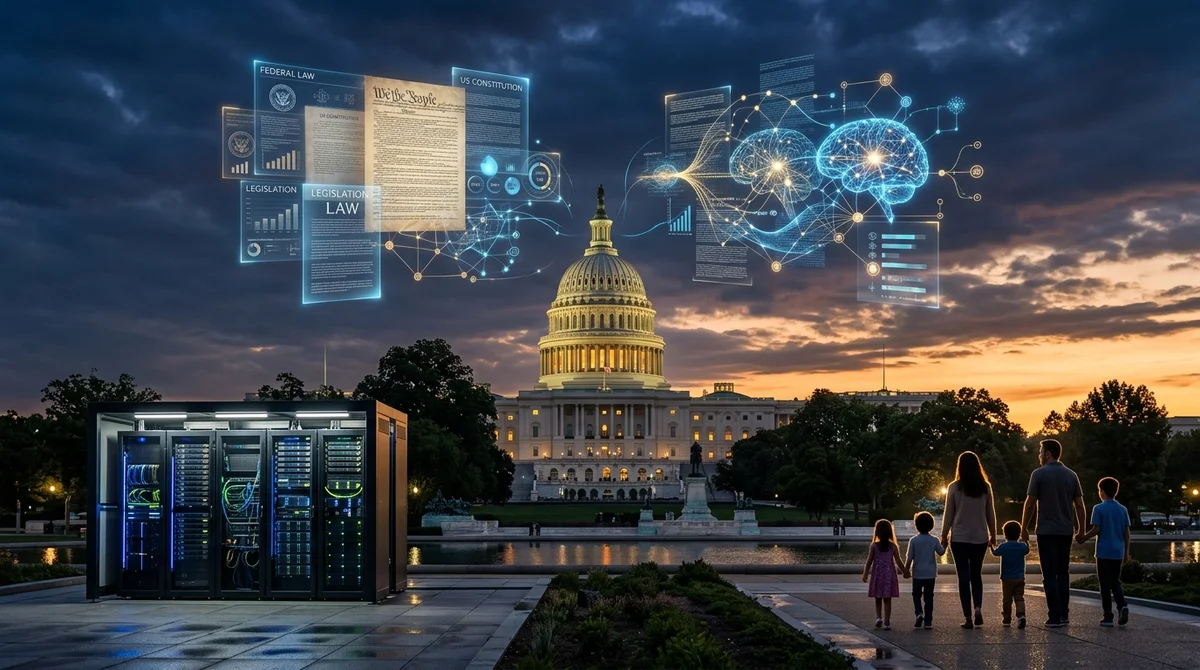
The Trump administration has published a framework document on regulating artificial intelligence that sets the tone for American AI policy for the next several years. It rests on three main theses: federal rules prevail over state laws, innovation takes priority, and responsibility for children's safety online shifts from platforms to parents.
The key principle is federal primacy. The US is a federation in which states traditionally can pass their own technology laws. In recent years several states, including California, Texas and Illinois, have drafted their own AI laws with requirements considerably stricter than those at the federal level. Trump's strategy states directly that federal regulation takes precedence. That means stricter state rules are effectively nullified, and businesses get a single, more predictable and more lenient regulatory regime.
The second principle is a bet on competitiveness. The document stresses that the US must lead the AI race, above all against China. Any regulation that slows innovation is treated as a threat to national interests. In formal terms: when a choice has to be made between reducing risks and accelerating development, development wins. The logic is that losing the AI race is more dangerous than weak regulatory oversight.
The third principle concerns children, and it is the most contentious. The previous approach held that platforms bear legal responsibility for restricting minors' access to potentially harmful content. The new strategy shifts the emphasis: primary responsibility falls on parents. Platforms are still required to provide parental control tools, but if families don't use them, that is now the family's problem, not the company's. This is a substantial change that eases pressure on Big Tech over moderating AI content for children.
For tech companies, the strategy is unambiguously good news. The regulatory burden shrinks and legal uncertainty disappears: instead of a patchwork of 50 different rule sets, there is one federal standard. OpenAI, Google, Meta* and thousands of startups can build products under more liberal conditions than in the EU, where the AI Act provides for fines of up to 6% of turnover.
For child-rights advocates, the document is an alarm signal. They argue that shifting responsibility to parents looks appealing in theory, but in practice most families have neither the technical knowledge nor the time to properly supervise the AI tools their children use. Research shows that teenagers often reach unwanted content through AI chatbots and image generators, especially when platforms don't introduce strict default restrictions.
The framework is part of a broad reversal in AI policy. In early 2025, Trump rescinded Biden's executive order on AI safety, calling it an obstacle to innovation. He then formed an advisory AI council with leading tech companies and announced $500 billion in AI infrastructure investment under the Stargate project.
The current document is not a law; it is a policy declaration. Real regulation requires passage through Congress, and states will most likely challenge federal primacy in court, especially California, which traditionally goes its own way.
Trump's American AI strategy is a deliberate choice of speed and competition over caution. The EU and the US continue to diverge: the European AI Act strictly regulates high-risk systems, while the American approach bets on market self-regulation. Whether that proves the right call, the coming years will show.
*Meta is designated an extremist organization and banned in Russia.
- Nov 2, 2026Meta's Muse assistant keeps dossiers on loved ones and gets root on Ubuntu by default
- Nov 1, 2026Local models lose to Opus and Codex: 0.21 on a MacBook versus 1.00 for Codex
- Nov 1, 2026Kimi scores 96.2% on a 1C database analytics test and emerges as a fallback if Claude access is blocked
- Nov 1, 2026OpenAI Rewrites GPT Behavior Rules: Five Values and a Chain of Command
Test Frontier LLMs & Autonomous Agents in One Workspace
Run Claude Opus 5.5, GPT-6, Gemini 3.1, and DeepSeek side-by-side in Nomad AI (nomadnet.ai) — unified model routing, deep research, and multimodal workflows under one subscription.
The AI world, distilled — once a week
Seven stories that actually mattered, hand-picked. No noise, no reposts, no press releases.
Done! Check your inbox for a confirmation.