Google builds a four-partner chip supply chain to challenge Nvidia in AI inference
Google is assembling a supply chain of AI chips with four partners to challenge Nvidia in inference. The partners are Broadcom, MediaTek, Marvell and Intel. The roadmap covers the Ironwood TPU, already shipping in the millions, and TPU v8 chips on TSMC's 2nm process, due by the end of 2027.
AI-processed from TNW; edited by Hamidun News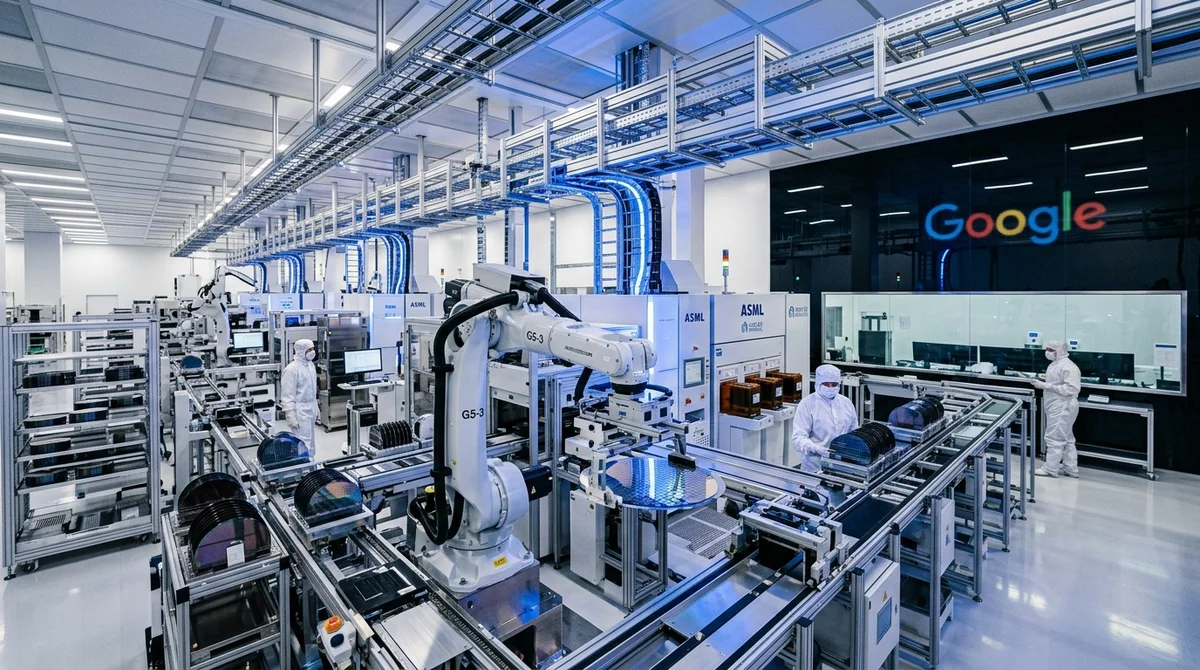
Google has announced the most diversified custom-chip supply chain in the AI industry, with four design partners and a roadmap running through the end of 2027. The company is betting that it can reduce the cloud market's dependence on Nvidia in AI inference.
Google's partner network includes four major players: Broadcom, MediaTek, Marvell and Intel. Each handles a separate area of chip architecture and manufacturing. The strategy was laid out in detail ahead of Google Cloud Next, the company's key annual event for enterprise customers and partners.
The first product of this ecosystem is the Ironwood TPU, a next-generation chip that is already shipping in the millions. It is the first sign that Google is ceasing to be merely a consumer of other companies' hardware and is steadily becoming a self-sufficient player in the AI infrastructure market.
The roadmap ends with TPU v8 chips, which will be manufactured on TSMC's 2nm process and arrive in the second half of 2027. Google's strategy splits the next generations of TPU into several independent streams, by design partner and by manufacturing capacity. This approach hedges against the supply disruptions typical of depending on a single vendor, and gives flexibility in scaling performance for different inference workloads.
Inference, meaning running already-trained models to generate answers for users, became the main battleground of the AI chip market in 2025–2026. This is where the main demand from large cloud providers is concentrated: a model is trained once, while inference runs continuously.
Nvidia retains its dominance thanks to its GPU architecture and the mature CUDA ecosystem, but Google's custom TPUs have traditionally shown better energy efficiency on transformer-model workloads.
For the market, this means stiffer competition in cloud AI hardware. If Google manages to scale its own supply chain to the required volumes, its customers will get a real alternative to Nvidia GPU clusters, with potentially lower inference cost per token and less dependence on a single supplier.
- Nov 2, 2026Karpathy builds a YouTube clone with 6454 videos from Hacker News recommendations in two hours
- Nov 2, 2026Karpathy used Claude to build HackerTube from 6,454 videos recommended on Hacker News
- Nov 2, 2026Anthropic needs to grow revenue 32% a year to cover $850 billion in contracts
- Nov 2, 2026Bun creator uses Claude Code to port 750K lines from Zig to Rust in 11 days
Test Frontier LLMs & Autonomous Agents in One Workspace
Run Claude Opus 5.5, GPT-6, Gemini 3.1, and DeepSeek side-by-side in Nomad AI (nomadnet.ai) — unified model routing, deep research, and multimodal workflows under one subscription.
The AI world, distilled — once a week
Seven stories that actually mattered, hand-picked. No noise, no reposts, no press releases.
Done! Check your inbox for a confirmation.