Google DeepMind and South Korea Launch Partnership for AI-Driven Scientific Breakthroughs
Google DeepMind has announced a partnership with South Korea to speed up scientific research with advanced AI models. An AI Campus will open in Seoul, where scientists and universities can work with AlphaFold, AlphaGenome, WeatherNext and AI co-scientist. The focus is on biomedicine, climate and energy, along with training new AI talent and offering internships to Korean students.
AI-processed from DeepMind Blog; edited by Hamidun News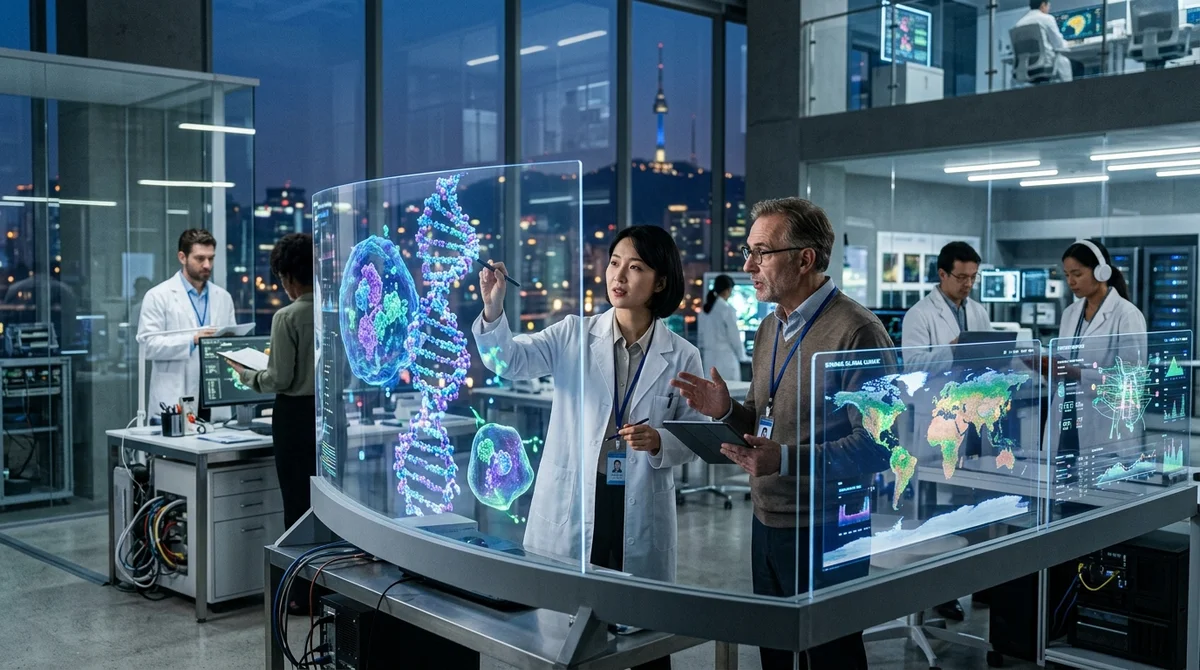
Google DeepMind has announced a new partnership with South Korea's Ministry of Science and ICT, and it is not just another memorandum of intent. The two sides want to build advanced AI models directly into scientific work, from genomics and drug discovery to extreme-weather forecasting and power-grid management. For South Korea, it is a way to accelerate research in strategic fields. For DeepMind, it is a chance to extend the practical use of its science models beyond the lab and make them part of national research infrastructure.
The partnership was announced on April 27, 2026, almost ten years after the AlphaGo match in Seoul, which for a wide audience became a symbol of what modern AI can actually do. The new project is part of Google DeepMind's National Partnerships for AI initiative and is tied to Korea's national AI strategy.
The company stresses that the country is already in a strong position: according to data DeepMind cites, Korea leads in AI innovation density and shows the fastest growth in AI adoption among the 30 largest economies. Against this backdrop, the Ministry of Science and ICT launched the K-Moonshot Missions program, which is meant to deliver a leap in research productivity and help tackle major national challenges.
To support this agenda, Google will open an AI Campus in its Seoul office, a venue where Korean universities and research centers can work with company experts, take part in programs and get access to advanced tools. The partnership also coincides with the launch of the new National AI for Science Center, which the country's authorities plan to open in May.
In the first phase, Google DeepMind plans to work with Seoul National University, KAIST and three state-run AI Bio Innovation Hubs. The point is not simply to show model demos but to build the models into the actual research cycle.
The tools the company names explicitly include:
- AlphaEvolve, a Gemini-based agent for designing and optimizing algorithms;
- AlphaGenome, a model for analyzing how mutations in human DNA affect gene function;
- AlphaFold, which, according to DeepMind, more than 85,000 researchers in Korea already use;
- AI co-scientist, a multi-agent system that acts as a virtual scientific collaborator for generating and testing hypotheses.
WeatherNext is a separate track: it is meant for analyzing extreme weather events, improving power-grid resilience and integrating renewable generation into the grid more efficiently. If the plan works, AI here will serve not as a general assistant for writing or search, but as a specialized research layer on top of existing scientific infrastructure.
The deal is not limited to model access. Google DeepMind is also betting on talent and safety. The company promises to expand contacts with Korean students and researchers, including working out internships inside DeepMind. This complements a broader package of Google initiatives in the region, which already includes 50,000 AI Essentials scholarships for people learning basic AI skills.
In parallel, DeepMind plans to work with Korea's AI Safety Institute on research and best practices for the safety of frontier models. That is an important signal: the partnership is built not only around accelerating science, but also around how to deploy such systems in government and academia without losing control over risks and without a gap between a model's lab capabilities and the demands of a real scientific environment.
What matters in this news is not only that one more country has struck a deal with a major AI lab. More important is that science models such as AlphaFold and WeatherNext are gradually moving from the category of headline technology achievements into the category of infrastructure on which states plan to build research, education and industrial policy.
For South Korea, it is a chance to turn its strong university and engineering base into applied discoveries in biomedicine, energy and climate faster. For Google DeepMind, it is an opportunity to establish itself as a supplier not only of general-purpose models but also of a specialized AI stack for science. If the Seoul project works as described, it will be one more example of the AI race shifting from chatbots to laboratories, power grids and biomedical platforms.
- Nov 2, 2026Karpathy builds a YouTube clone with 6454 videos from Hacker News recommendations in two hours
- Nov 2, 2026Karpathy used Claude to build HackerTube from 6,454 videos recommended on Hacker News
- Nov 2, 2026Anthropic needs to grow revenue 32% a year to cover $850 billion in contracts
- Nov 2, 2026Bun creator uses Claude Code to port 750K lines from Zig to Rust in 11 days
Test Frontier LLMs & Autonomous Agents in One Workspace
Run Claude Opus 5.5, GPT-6, Gemini 3.1, and DeepSeek side-by-side in Nomad AI (nomadnet.ai) — unified model routing, deep research, and multimodal workflows under one subscription.
The AI world, distilled — once a week
Seven stories that actually mattered, hand-picked. No noise, no reposts, no press releases.
Done! Check your inbox for a confirmation.