SmolAgents: How to Build a Multi-Agent AI System with Code Execution and Dynamic Orchestration
SmolAgents is presented as a foundation for a production-ready multi-agent system: agents can reason, run code, connect tools and delegate tasks to one another. The walkthrough covers setting up the LLM backend, working with memory and math utilities, and the logic of dynamic orchestration. The result is a clear template for moving from an ordinary chatbot to a controllable AI pipeline that can grow to fit real product scenarios.
AI-processed from MarkTechPost; edited by Hamidun News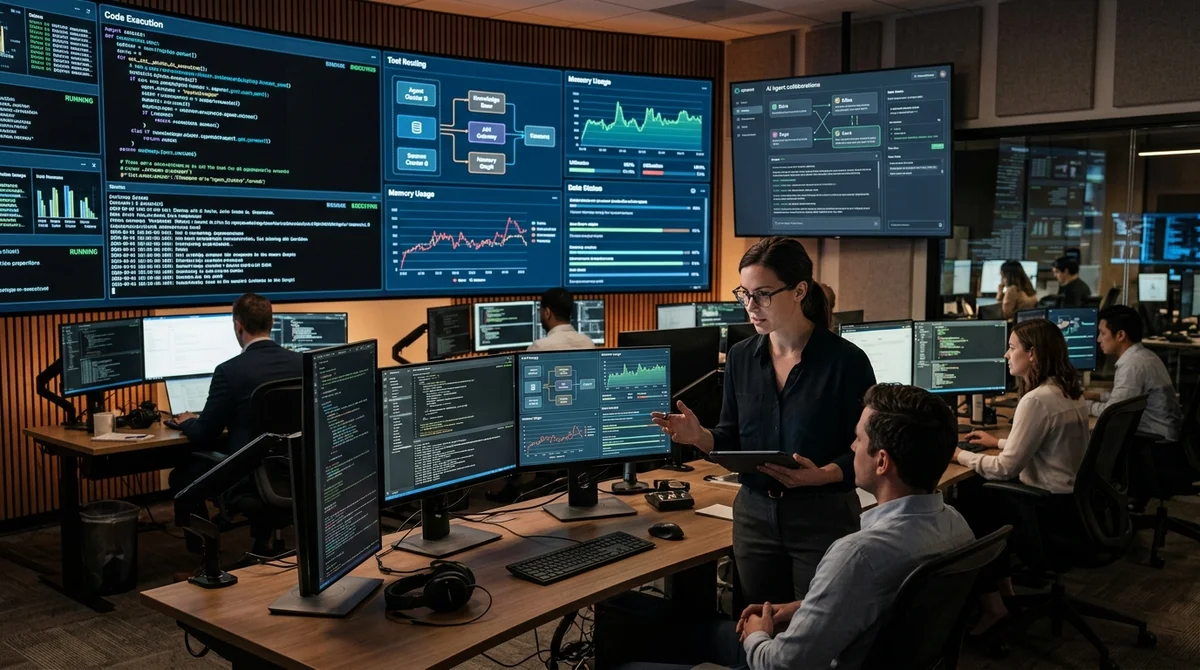
SmolAgents shows that multi-agent AI systems don't have to be heavy or hard to maintain. In the implementation examined here, the authors build an applied architecture in which small agents can reason, run code, pick tools for the task and hand work off to each other. The goal is not to demo yet another chat with functions, but to lay a foundation for production-ready scenarios in which the agent acts as an executor rather than a text generator.
The walkthrough begins with a basic but critical layer: installing dependencies and configuring the LLM backend. The authors stress that a multi-agent setup depends not only on model strength but also on efficiency, because every extra reasoning step, tool call or delegation between agents raises cost and latency. The architecture is therefore built around lightweight components that can be combined and extended without overloading the system. This approach is especially useful for teams that want to test ideas quickly and then turn them into a working service.
The next step is tool design. The example uses custom utilities, including math functions, a memory store and helper components that the agent can call as needed. This matters: instead of one universal model trying to know everything, the system gets a set of specialized capabilities. When an agent can check memory, compute an expression or run a piece of code instead of guessing the answer, the quality of its decisions becomes more predictable and its behavior easier to verify.
Code execution gets particular attention. In agent systems, this mechanism is often the line between a polished demo and real automation. If a model can generate Python code, run it in a controlled environment and return the result to the shared context, it can do more than explain: it can process data, transform structures, perform calculations and prepare intermediate artifacts for other agents. Combined with tool calling, this makes SmolAgents a convenient framework for tasks that need a loop of understand, decide, verify and pass along.
The key part is dynamic orchestration. The authors show how several agents can collaborate inside one system, dividing roles and switching between tools depending on the type of task. One agent can act as coordinator, another as code executor, a third can work with memory or a separate knowledge domain. This setup helps break complex requests into more manageable steps, reduce hallucinations and create clear control points. In production this matters a great deal: the clearer the decision path, the easier it is to debug errors, limit risks and measure results.
Another strength of the approach is modularity. When memory, computation and external actions are separated into tools, the system is easier to update: you can swap the model, add a new tool, tighten the code sandbox or rewrite the routing logic without breaking the whole pipeline. This reduces dependence on a single model and brings agent architecture closer to ordinary backend development, where interfaces, observability and control over state matter. For teams building internal copilot services, research assistants or operations automation, this kind of engineering discipline often matters more than one-off wow demos.
The practical value of the tutorial is that it moves the conversation about multi-agent systems from concepts to engineering implementation. In this context, SmolAgents looks like a lightweight but sufficiently flexible tool for building agent pipelines with memory, code and a set of external functions. For developers, it is a good template for starting not with a super-agent but with small, transparent components that can be tested separately and gradually combined into a working system. That approach looks the most viable today for applied AI, where what counts is not promises but controllability, cost and reproducible results.
- Nov 2, 2026Karpathy builds a YouTube clone with 6454 videos from Hacker News recommendations in two hours
- Nov 2, 2026Karpathy used Claude to build HackerTube from 6,454 videos recommended on Hacker News
- Nov 2, 2026Arca gives AI agents finance tasks lasting up to 10 days, but leaves the trades to humans
- Nov 2, 2026DeepSeek open-sources Super-agent prototype: p95 task completion time of 15.7 minutes vs. 29.5
Test Frontier LLMs & Autonomous Agents in One Workspace
Run Claude Opus 5.5, GPT-6, Gemini 3.1, and DeepSeek side-by-side in Nomad AI (nomadnet.ai) — unified model routing, deep research, and multimodal workflows under one subscription.
The AI world, distilled — once a week
Seven stories that actually mattered, hand-picked. No noise, no reposts, no press releases.
Done! Check your inbox for a confirmation.