US agencies are testing Anthropic's Mythos again, despite Trump's ban
In the US, the formal ban on working with Anthropic is diverging from practice: federal agencies and congressional committees continue to test the Mythos model behind closed doors. Officials are interested in its capabilities in cyberdefense, vulnerability discovery and systems auditing. Against the backdrop of the company's conflict with the Pentagon, this looks like a rare case in which the value of an AI tool outweighs a harsh political and administrative decision.
AI-processed from 3DNews AI; edited by Hamidun News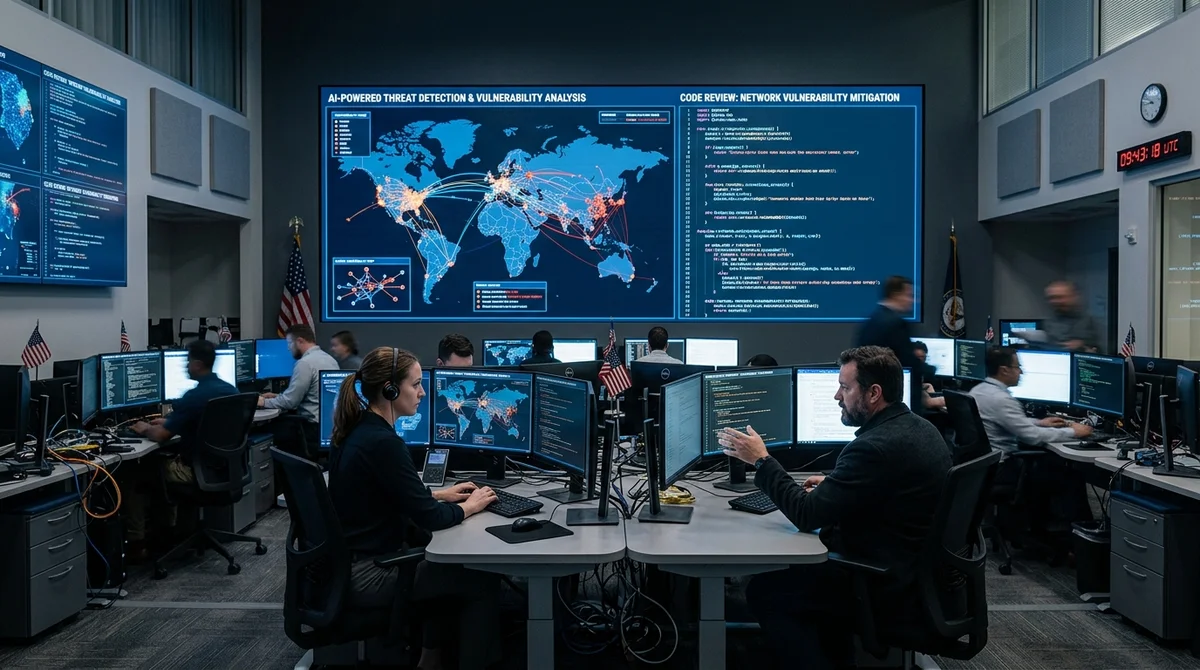
The White House's formal ban on working with Anthropic has proved weaker than American officials' interest in the new Mythos model: federal agencies and congressional staff keep requesting access to the system because its cyber capabilities are too valuable to wait for the political conflict to end.
According to Politico, the Center for AI Standards and Innovation at the US Department of Commerce is already testing Mythos for its ability to find and exploit vulnerabilities. This is not a theoretical assessment but a practical check of how useful the model is for cyberdefense and systems auditing. Over the past week, staff from at least three congressional committees held or requested closed briefings from Anthropic to understand how Mythos could be used to scan cyber infrastructure. Meanwhile, Anthropic co-founder Jack Clark said the company is discussing the model's capabilities with the administration of Donald Trump itself, even though the Pentagon earlier cut business ties with the developer.
The interest in Mythos is understandable. On April 7, 2026, Anthropic presented the system as its most powerful model for programming and agentic tasks, that is, tasks in which the AI does not simply answer a query but acts more autonomously. In company materials and US press coverage, Mythos is described as a tool on the level of an advanced security researcher: the model can find huge numbers of vulnerabilities, reproduce them and assemble working exploits. In internal tests reported by Axios, it successfully produced a proof-of-concept exploit on the first attempt in 83.1% of cases, found bugs in major operating systems and browsers, and even identified very old vulnerabilities that had long gone unnoticed in routine checks.
That is exactly why Anthropic did not release Mythos publicly. The company decided to limit the model to a circle of vetted organizations and to use it primarily in a defensive mode: to check its own code, open-source projects and critical infrastructure. Under Project Glasswing, more than 40 organizations, including major cloud and IT players, were brought into testing, and substantial credits were allocated for working with the model. The logic is simple: if such systems can already dramatically speed up vulnerability discovery, it is better for governments and large corporations to use them to defend their networks before similar capabilities end up widely in the hands of attackers.
Against this backdrop, the official conflict around Anthropic looks even more telling. In early March 2026, the Pentagon designated the company a supply-chain risk after a dispute over the terms of use of its models in military settings. According to US media, Anthropic tried to keep its bans on using its systems for fully autonomous weapons and mass domestic surveillance, and the authorities deemed such restrictions unacceptable.
After that, the company's access to a number of federal procurement channels was effectively cut off, and the White House demanded an end to work with Anthropic through government channels. The developer is challenging these actions in court, arguing that the punishment is punitive in nature and goes far beyond an ordinary contract dispute.
The situation shows a moment, rare for the AI market, in which the state's political line has come into direct conflict with the practical interests of its own agencies. For the Pentagon, the issue comes down to control over the supplier and the conditions of use of the model. For civilian bodies and lawmakers, the priority now is different: to get a tool that helps find weaknesses in software faster and reduce the risk of major breaches. So at the bureaucratic level, the ban is starting to erode before the dispute has been resolved legally or politically.
The main takeaway is that Mythos has become not just another high-profile model but a test of how states will handle dual-use AI tools. If a system strengthens both defense and potential attack, a full ban is hard to sustain in practice. The Anthropic story shows that when it comes to cybersecurity and national-scale vulnerabilities, agencies are prepared to circumvent even harsh political decisions so as not to lose access to the technology.
- Nov 2, 2026Karpathy builds a YouTube clone with 6454 videos from Hacker News recommendations in two hours
- Nov 2, 2026Karpathy used Claude to build HackerTube from 6,454 videos recommended on Hacker News
- Nov 2, 2026Arca gives AI agents finance tasks lasting up to 10 days, but leaves the trades to humans
- Nov 2, 2026Anthropic needs to grow revenue 32% a year to cover $850 billion in contracts
Test Frontier LLMs & Autonomous Agents in One Workspace
Run Claude Opus 5.5, GPT-6, Gemini 3.1, and DeepSeek side-by-side in Nomad AI (nomadnet.ai) — unified model routing, deep research, and multimodal workflows under one subscription.
The AI world, distilled — once a week
Seven stories that actually mattered, hand-picked. No noise, no reposts, no press releases.
Done! Check your inbox for a confirmation.