Nvidia puts $2 billion into Marvell and turns a partnership into an infrastructure toll
Nvidia has invested $2 billion in Marvell and folded the company into its NVLink Fusion ecosystem. The point of the deal is not just the stake: any custom AI accelerator Marvell builds for Amazon, Google and Microsoft would still pull Nvidia components along with it. That lets Nvidia tighten its grip on connectivity, photonics and the networking side of AI infrastructure.
AI-processed from TNW; edited by Hamidun News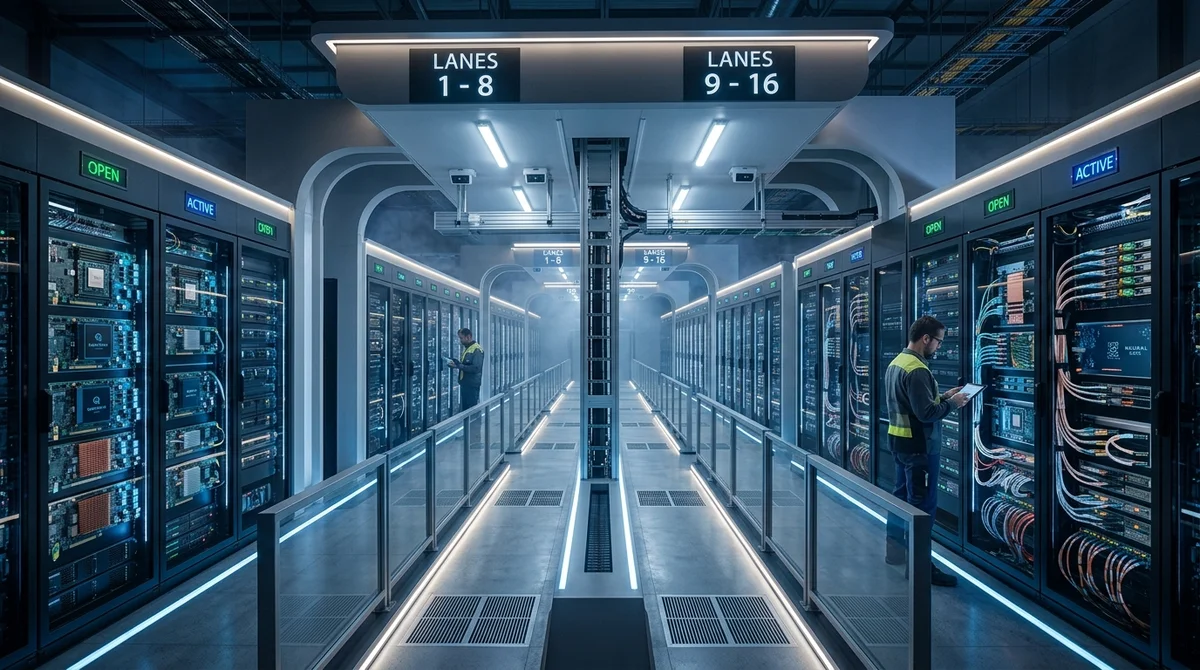
Nvidia has invested $2 billion in Marvell, but the real intrigue of the deal is neither the size of the check nor portfolio logic. What matters more is that Marvell becomes part of NVLink Fusion, an ecosystem through which Nvidia wants to control not only the market for off-the-shelf GPUs but also the layer of mandatory infrastructure around custom AI chips. If the scheme works, large cloud platforms will be able to order specialized accelerators of their own, but fully leaving Nvidia's orbit will still be much harder for them.
Marvell has long held strong positions where the real fight in AI infrastructure now begins: custom chips, high-speed interconnects, silicon photonics and telecom. The partnership covers several of these areas at once: custom AI accelerators, silicon photonics and 5G/6G infrastructure.
This matters because, in the model race, the market is no longer constrained only by the performance of a single processor. The bottlenecks are data exchange between chips, bandwidth, latency, power consumption and the cost of scaling large clusters. Here the platform starts to matter as much as the compute unit itself.
That is the strategic logic of NVLink Fusion. Nvidia is effectively trying to make sure its components remain a mandatory part of the system even when it is not the one designing the main accelerator. For hyperscalers such as Amazon, Google and Microsoft, a custom chip is a way to reduce dependence on expensive general-purpose GPUs and optimize hardware for specific workloads. But if such a chip still needs Nvidia's interfaces, networking elements and other platform layers, the buyer seemingly moves away from the company's standard product yet keeps paying it for the right to plug into familiar AI infrastructure. That is why the arrangement is better seen as an infrastructure toll than as an ordinary minority investment.
For Nvidia itself, this is both defense and expansion. Defense, because the market has long been moving toward customization, and the biggest cloud players do not want to depend on a single supplier and are building up their own chip development programs. If that trend strengthens, simply betting on sales of off-the-shelf GPUs will no longer be enough. Expansion, because Nvidia is moving its power to the next level: from selling an accelerator to controlling the connection and compatibility standard. In that scenario the company earns not only on compute but on the architecture of access to it.
Marvell also gets clear benefits: direct financial resources of $2 billion, a closer tie to the most influential player in the AI market, and added appeal to customers who want to build custom solutions without assembling system integration from scratch.
It also matters that the partnership goes beyond pure AI accelerators. The mention of silicon photonics and 5G/6G shows that this is a broader grab for the infrastructure layer. For the industry, it is a signal: the next big money in AI will be split not only among chipmakers but also among those who control interconnects, optics, network standards and component compatibility.
The main takeaway is simple: Nvidia is trying to make sure that alternatives to it earn it as much money as direct sales. If the Marvell strategy works, the AI hardware market will not operate on the principle of openly swapping one chip for another, but on paid passage through key infrastructure nodes. For customers, this means tighter ties to the Nvidia ecosystem even when they bet on custom hardware. For competitors, it means they will have to fight not only for the best accelerator but also for the right to set the rules for connecting everything else.
- Nov 2, 2026Anthropic needs to grow revenue 32% a year to cover $850 billion in contracts
- Nov 2, 2026TensorFold 1.2.0 boosts Qwen3.8-27B throughput on M3 Ultra by 44.2% at 16 streams
- Nov 1, 2026Local models lose to Opus and Codex: 0.21 on a MacBook versus 1.00 for Codex
- Nov 1, 2026Habr author fine-tunes YOLOv8l on dental X-rays and pushes mAP50 to 0.642
Test Frontier LLMs & Autonomous Agents in One Workspace
Run Claude Opus 5.5, GPT-6, Gemini 3.1, and DeepSeek side-by-side in Nomad AI (nomadnet.ai) — unified model routing, deep research, and multimodal workflows under one subscription.
The AI world, distilled — once a week
Seven stories that actually mattered, hand-picked. No noise, no reposts, no press releases.
Done! Check your inbox for a confirmation.