Sber releases Kandinsky 6.0 Image Pro, a single model for image generation and editing
Sber has updated its Kandinsky lineup with 6.0 Image Pro, a single model that handles both image generation and editing. According to the company, it performs on par with Flux 2 Max, beats GPT Image 1.5, and runs more than 40% faster than the previous version. Under the hood is Image RAG, which helps the model better understand cultural context and edit scenes, objects, and archival photos more precisely.
AI-processed from Habr AI; edited by Hamidun News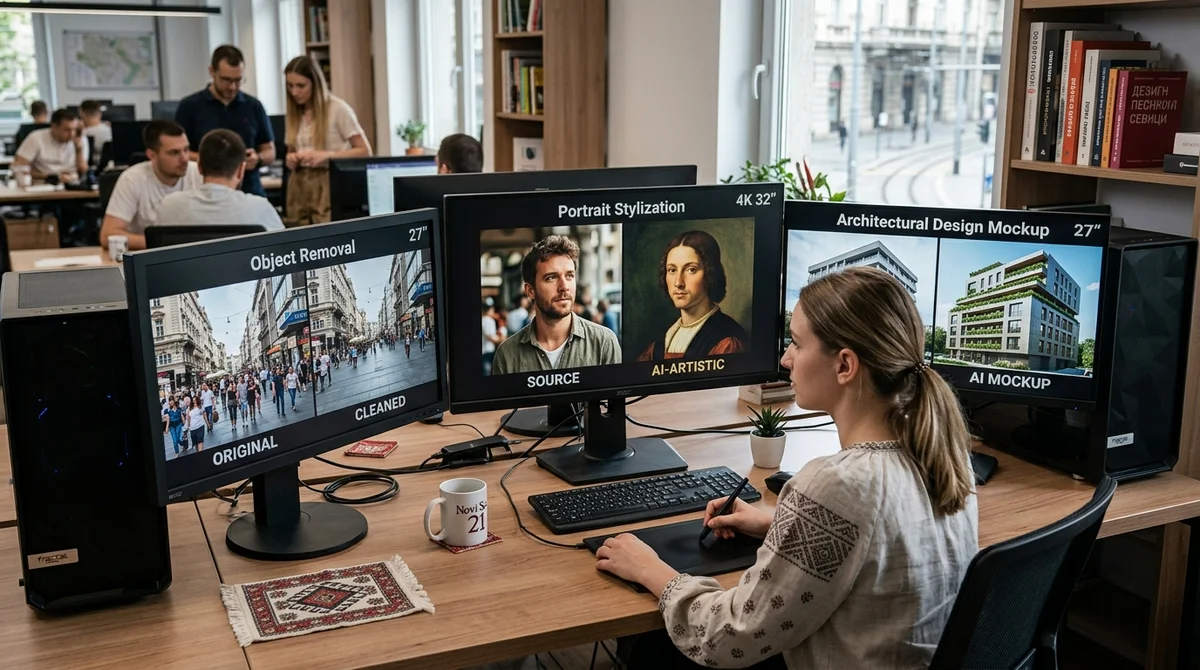
Sber has unveiled Kandinsky 6.0 Image Pro, a new unified model that combines image generation and editing. The company is emphasizing more than text-to-image quality: the main focus is on precise, targeted edits and complex editing scenarios.
What's new
The new version merges text-to-image generation and image editing into a single model. That marks a significant shift from the previous Kandinsky 5 lineup, which spread its focus across several modes and separate model variants. The user workflow gets shorter: the same tool handles both the first render and later edits to the scene.
Sber is now pushing one core product for both tasks, from creating an image from scratch to swapping objects, stylizing photos, and making local edits to a finished shot. According to the company's internal comparisons, Kandinsky 6.0 Image Pro performs on par with Flux 2 Max and outperforms GPT Image 1.5.
Sber also notes that the model has become more stable at text-to-image generation, but editing is the main focus of this release. To get there, the team moved the architecture to MoE, parallelized inference, and optimized the attention mechanism. As a result, the company says, the new version runs more than 40% faster than its predecessor.
In comparative testing,
Kandinsky 6.0 Image Pro performs on par with Flux 2 Max and outperforms GPT Image 1.5.
Why Image RAG matters
One of the key additions is Image RAG integration. Put simply, when a user submits a request, the system searches a knowledge base for relevant visual references and, when needed, adds them to the model's context. This helps the generator grasp not only general styles and objects but also narrower cultural, historical, and local details that general-purpose models usually struggle with.
The approach is meant to improve accuracy where typical generative models get details wrong or swap local specifics for more generic imagery. The practical upside is that the model's knowledge can be expanded without full retraining.
In its article, Sber shows examples drawn from Russia's own cultural heritage: the model correctly reproduces Mezen painting, the kartuz cap, and other distinctive visual details. The same mechanism works in editing mode. For instance, a user can insert themselves into a scene with a favorite movie character, provided the system finds relevant visual context and blends it into the image correctly.
Where it fits
The use cases for Kandinsky 6.0 Image Pro are decidedly practical. This is no longer just about generating pretty pictures from a prompt; it's about editing existing images without fiddling around in a graphics editor and without noticeably breaking the scene's coherence.
In other words, Sber is trying to turn the model from a demo neural network into a working tool for designers, marketers, e-commerce teams, architects, and anyone who regularly makes quick visual edits.
- Removing objects, graffiti, and text while preserving the background
- Replacing items while matching the original style of the shot
- Stylizing portraits while preserving facial features
- Restoring and colorizing old photographs
- Generating exteriors and interiors from a description or a floor plan
The article also shows cases where the model changes lighting, backgrounds, hairstyles, makeup, clothing, and even facial expressions. Sber specifically mentions integration with the "Immortal Regiment Online" service, where Kandinsky is used to restore archival photos of veterans.
This is not just a showcase feature for promo purposes but a real-world workflow where both careful editing and predictable results matter. For the local market, it's one of the clearest examples of the technology's practical use.
Kandinsky 6.0 Image Pro is currently available across GigaChat platforms: in Telegram, the Max messenger, on giga.chat, and in the Android app. In upcoming updates, Sber promises to add editing based on three references and a more detailed brush mode, letting users point to a specific area of the image and indicate exactly what to add or remove.
That brings the product closer to the familiar logic of working in an image editor, but with a generative model under the hood.
What it means
Russian image generation models are increasingly moving out of the "check out the demo" category and into the category of working tools.
If Kandinsky 6.0 Image Pro actually holds its claimed speed and quality under mass use, the local market will gain another strong tool for design, marketing, e-commerce, and archival photo restoration, especially where Russian visual context matters.
- Nov 2, 2026Karpathy builds a YouTube clone with 6454 videos from Hacker News recommendations in two hours
- Nov 2, 2026Karpathy used Claude to build HackerTube from 6,454 videos recommended on Hacker News
- Nov 2, 2026Microsoft releases 4B model Mage-VL-Cowork, which solves 66.0% of OSWorld-Verified tasks
- Nov 2, 2026TensorFold 1.2.0 boosts Qwen3.8-27B throughput on M3 Ultra by 44.2% at 16 streams
Key Questions Answered
What's new?
The new version merges text-to-image generation and image editing into a single model. That marks a significant shift from the previous Kandinsky 5 lineup, which spread its focus across several modes and separate model variants. The user workflow gets shorter: the same tool handles both the first render and later edits to the scene. Sber is now pushing one core product for both tasks, from creating an image from scratch to swapping objects, stylizing photos, and making local edits to a finished shot. According to the company's internal comparisons, Kandinsky 6.0 Image Pro p
Why Image RAG matters?
One of the key additions is Image RAG integration. Put simply, when a user submits a request, the system searches a knowledge base for relevant visual references and, when needed, adds them to the model's context. This helps the generator grasp not only general styles and objects but also narrower cultural, historical, and local details that general-purpose models usually struggle with. The approach is meant to improve accuracy where typical generative models get details wrong or swap local specifics for more generic imagery. The practical upside is that the model's knowled
Where it fits?
The use cases for Kandinsky 6.0 Image Pro are decidedly practical. This is no longer just about generating pretty pictures from a prompt; it's about editing existing images without fiddling around in a graphics editor and without noticeably breaking the scene's coherence. In other words, Sber is trying to turn the model from a demo neural network into a working tool for designers, marketers, e-commerce teams, architects, and anyone who regularly makes quick visual edits. Removing objects, graffiti, and text while preserving the background Replacing items while matching the
Test Frontier LLMs & Autonomous Agents in One Workspace
Run Claude Opus 5.5, GPT-6, Gemini 3.1, and DeepSeek side-by-side in Nomad AI (nomadnet.ai) — unified model routing, deep research, and multimodal workflows under one subscription.
The AI world, distilled — once a week
Seven stories that actually mattered, hand-picked. No noise, no reposts, no press releases.
Done! Check your inbox for a confirmation.