Sber launches Kandinsky 6 Image: the image generator gets faster and learns to restore photos
Sber has released Kandinsky 6 Image and built it into GigaChat, with free access and no cap on the number of generations. The new version is twice as fast, handles complex prompts more accurately, and adds editing tools: restoring old photos, swapping backgrounds and clothing, local retouching, makeup, built-in search for visual references, and the option to animate the finished result afterward. The model uses a Mixture of Experts architecture, which activates only the relevant parts of the network for each request. Sber says this means faster processing and fewer errors on complex scenes. The release also reflects a broader shift: competition in generative imaging is moving from who draws best from a prompt to who offers a complete set of tools in a single window.
AI-processed from 3DNews AI; edited by Hamidun News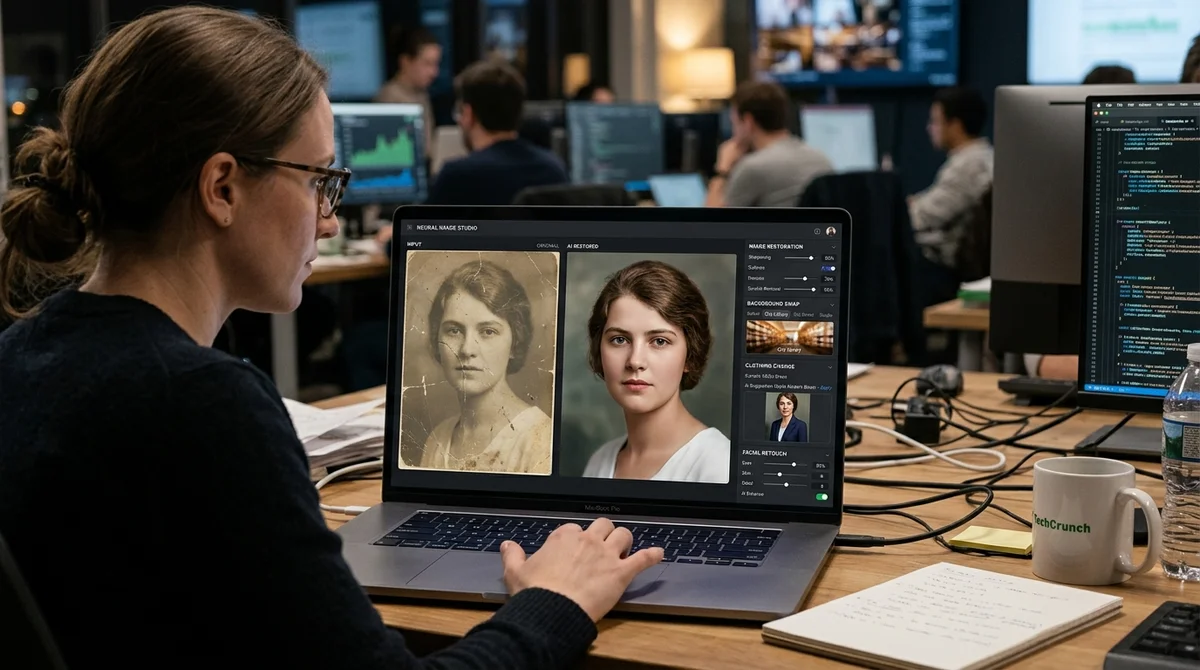
Sber has updated its image model and built Kandinsky 6 Image into GigaChat. The new version bets not only on text-to-image generation but also on full-fledged editing: from restoring old photos to precisely correcting individual details and preparing images for further animation.
What has changed
Kandinsky 6 Image is available directly inside GigaChat, and for users this is arguably the main practical change. The model can be used for free and with no limit on the number of tasks, which means this is not a one-off demonstration of capabilities but a service built for regular work.
According to Sber, the new version is twice as fast as the previous one, handles complex prompts better and produces more detailed images. This matters beyond people who like to experiment with prompts. The faster the model responds and the more accurately it holds on to details, the closer it gets to being an everyday tool for designers, marketers, small-shop owners and content creators. In these scenarios, generation as a flashy feature matters less than a predictable result that can go into a post, a product card, a banner or a presentation without lengthy rework.
On the technical side, the model now uses a Mixture of Experts architecture. In this approach, each request activates not the entire neural network but only the fragments it needs. For the user, this shows up not in abstract metrics but in faster processing and fewer errors on complex scenes that require holding many conditions at once: style, composition, characters, clothing, background and small objects in the frame.
New use cases
The main difference between Kandinsky 6 Image and an ordinary image generator is its expanded set of editing tools. The model now covers more tasks that previously had to be handled in several apps or by hand, especially when the user needs not to invent an image from scratch but to carefully improve an existing shot. The emphasis is clearly on everyday scenarios, not just on showcasing technological capabilities in promo videos for general users and teams.
- Restoration of old photographs
- Styling photos into different visual formats
- Neural photoshoots based on user images
- Changing clothing and backgrounds in photos
- Retouching and virtual makeup
Sber separately stresses that local edits have become more precise. This matters for anyone who works not with generation from scratch but with editing a finished picture. In such tasks the user usually needs to change one part of the image without wrecking the rest. If the model really preserves the original scene better and changes individual elements more cleanly, that makes it noticeably more useful for personal and commercial use.
Search and animation
Another notable addition is built-in image search. If the model does not know what a character or object the user asks for looks like, it can find a visual sample on its own. In practice, this should reduce misses in situations where a text description is not enough or where a current reference matters more than an averaged interpretation from the training data. For services of this class, it is a way to cut down on invented details and bring the result closer to what the user expects.
Generated images can be animated immediately through the linked Kandinsky Video model, which already runs in the GigaChat ecosystem. This turns the service from a simple image generator into a broader visual builder: the user first gets a still frame and can then quickly turn it into a short moving clip without switching to another product. For Sber, it is one more step toward making GigaChat seen as a universal AI assistant rather than just a text chatbot.
What this means
Kandinsky 6 Image shows that competition in generative graphics is shifting from the question of who draws best from a prompt to a more applied one: who gives the user a complete set of tools in one window. For the market, this means more mass-market services where generation, retouching, reference search and basic animation come together in a single workflow, without extra friction or switching between different apps, for a mass audience.
- Nov 2, 2026Microsoft releases 4B model Mage-VL-Cowork, which solves 66.0% of OSWorld-Verified tasks
- Nov 2, 2026TensorFold 1.2.0 boosts Qwen3.8-27B throughput on M3 Ultra by 44.2% at 16 streams
- Nov 2, 2026The Verge reviewer builds a $50 Meta Muse Charm alternative with Claude Code
- Nov 2, 20268 Skills for video in Claude Code: from 244 pixel effects to rough-cut editing
Key Questions Answered
What has changed?
Kandinsky 6 Image is available directly inside GigaChat, and for users this is arguably the main practical change. The model can be used for free and with no limit on the number of tasks, which means this is not a one-off demonstration of capabilities but a service built for regular work. According to Sber, the new version is twice as fast as the previous one, handles complex prompts better and produces more detailed images. This matters beyond people who like to experiment with prompts. The faster the model responds and the more accurately it holds on to details, the close
What are the key details on New use cases?
The main difference between Kandinsky 6 Image and an ordinary image generator is its expanded set of editing tools. The model now covers more tasks that previously had to be handled in several apps or by hand, especially when the user needs not to invent an image from scratch but to carefully improve an existing shot. The emphasis is clearly on everyday scenarios, not just on showcasing technological capabilities in promo videos for general users and teams. Restoration of old photographs Styling photos into different visual formats Neural photoshoots based on user images Ch
What are the key details on Search and animation?
Another notable addition is built-in image search. If the model does not know what a character or object the user asks for looks like, it can find a visual sample on its own. In practice, this should reduce misses in situations where a text description is not enough or where a current reference matters more than an averaged interpretation from the training data. For services of this class, it is a way to cut down on invented details and bring the result closer to what the user expects. Generated images can be animated immediately through the linked Kandinsky Video model, wh
Test Frontier LLMs & Autonomous Agents in One Workspace
Run Claude Opus 5.5, GPT-6, Gemini 3.1, and DeepSeek side-by-side in Nomad AI (nomadnet.ai) — unified model routing, deep research, and multimodal workflows under one subscription.
The AI world, distilled — once a week
Seven stories that actually mattered, hand-picked. No noise, no reposts, no press releases.
Done! Check your inbox for a confirmation.