SoftBank-backed $999 million deal shows the market is again funding AI data centers
The AI infrastructure market is taking on risk again. A data center developer is preparing a $999 million high-yield bond offering for a project leased by a SoftBank subsidiary. It is a test of investor appetite for new AI bets: the market is still willing to buy expensive debt when it is backed by computing capacity, a clear tenant, long-term utilization and expected demand growth. The deal shows that investors will still accept elevated risk when the asset is AI infrastructure and the facility already has a signed tenant.
AI-processed from Bloomberg Tech; edited by Hamidun News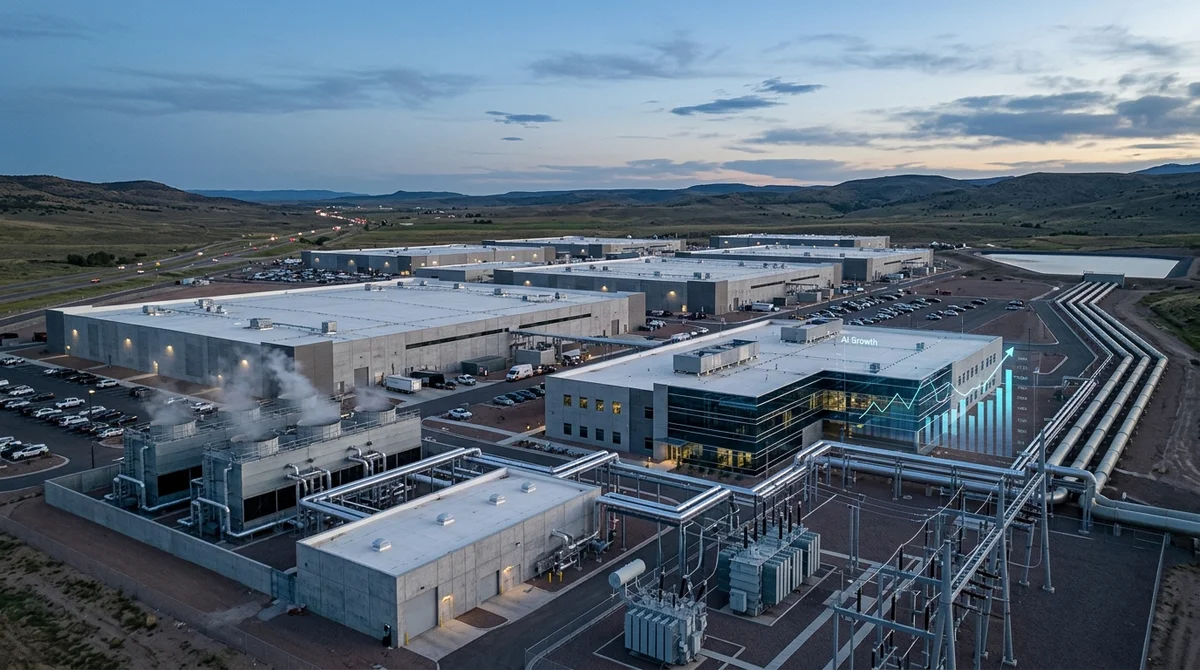
A data center project linked to SoftBank is coming to market with almost a billion dollars of high-yield debt. The $999 million deal shows that investors are still willing to take on extra risk when it comes to AI infrastructure and a facility with a tenant already signed.
Why the market is heading there
Over the past year, interest in AI infrastructure has shifted noticeably from chips and cloud services alone to more "down-to-earth" assets: buildings, racks, cooling systems and grid connections. Data centers have become the physical foundation of the AI boom, and therefore a new target for financial bets. When such a project is already tied to a major tenant, it is easier to sell to investors as a story about future cash flow, not just hype. That is why the market is watching these offerings closely.
High-yield, or "junk," bonds are usually issued by borrowers that have to pay more for capital because of higher risk. If demand for such debt holds up, it signals that investors believe demand for AI computing capacity will stay high long enough to justify an expensive financing model. In other words, the market is buying not just square footage, but the expectation that this capacity will stay in use for a long time.
How the deal works
The core of the deal is simple: a data center developer is offering investors almost $1 billion in bonds for a project leased by a SoftBank subsidiary. For the issuer, it is a way to raise large-scale financing without immediately selling a stake in the asset. For bond buyers, it is a chance to earn a higher yield if the project steadily generates rental income and meets its debt terms. It is also a market test: after a series of similar issues, it becomes clear whether capital is ready to keep flowing into AI infrastructure even at a risky profile.
- Offering size: $999 million
- Basis of the story: a data center project built for AI-related workloads
- Tenant: a SoftBank subsidiary
- Financing instrument: high-yield bonds
- Key question: will there be enough investor demand for the new risk
It also matters that in such deals investors weigh more than the tenant's brand. They want answers to more practical questions: when the facility will reach full capacity, whether there will be enough electricity, whether construction costs will rise, and how resilient the project's economics will be at high interest rates. In data centers, access to power and time to completion sometimes matter as much as demand for AI services.
What investors see
The SoftBank link makes the offering more visible because it gives the deal a clear reference point and reduces the sense that this is speculation out of thin air. But a prominent name does not remove the risks on its own. High-yield debt remains sensitive to any cooling in the capital market: if borrowing costs stay high for long, refinancing gets harder, and any delay in construction or launch starts to hurt the whole model.
On the other hand, the very appearance of new issues like this shows how quickly AI is changing how the industry is financed. Investors used to bet more on hardware makers, cloud platforms or public tech companies. Now money is flowing more actively into "bricks and wires," where the basic infrastructure for training and running models is built. If such deals keep coming to market, data centers are already seen as one of the main ways to buy exposure to the AI boom.
What it means
The AI boom is moving more visibly from software and chips into heavy infrastructure, which demands large upfront investment, access to power and a tolerance for risk. The SoftBank-linked deal shows that the market is ready to finance such projects with expensive debt if it sees a clear tenant and a chance of long-term use of the capacity. But an AI label is no longer enough: contracts, electricity and execution discipline are required.
Key Questions Answered
Why the market is heading there?
Over the past year, interest in AI infrastructure has shifted noticeably from chips and cloud services alone to more "down-to-earth" assets: buildings, racks, cooling systems and grid connections. Data centers have become the physical foundation of the AI boom, and therefore a new target for financial bets. When such a project is already tied to a major tenant, it is easier to sell to investors as a story about future cash flow, not just hype. That is why the market is watching these offerings closely. High-yield, or "junk," bonds are usually issued by borrowers that have t
How the deal works?
The core of the deal is simple: a data center developer is offering investors almost $1 billion in bonds for a project leased by a SoftBank subsidiary. For the issuer, it is a way to raise large-scale financing without immediately selling a stake in the asset. For bond buyers, it is a chance to earn a higher yield if the project steadily generates rental income and meets its debt terms. It is also a market test: after a series of similar issues, it becomes clear whether capital is ready to keep flowing into AI infrastructure even at a risky profile. Offering size: $999 mill
What investors see?
The SoftBank link makes the offering more visible because it gives the deal a clear reference point and reduces the sense that this is speculation out of thin air. But a prominent name does not remove the risks on its own. High-yield debt remains sensitive to any cooling in the capital market: if borrowing costs stay high for long, refinancing gets harder, and any delay in construction or launch starts to hurt the whole model. On the other hand, the very appearance of new issues like this shows how quickly AI is changing how the industry is financed. Investors used to bet m
Test Frontier LLMs & Autonomous Agents in One Workspace
Run Claude Opus 5.5, GPT-6, Gemini 3.1, and DeepSeek side-by-side in Nomad AI (nomadnet.ai) — unified model routing, deep research, and multimodal workflows under one subscription.
The AI world, distilled — once a week
Seven stories that actually mattered, hand-picked. No noise, no reposts, no press releases.
Done! Check your inbox for a confirmation.