OpenAI releases Privacy Filter, an open model for stripping personal data from text
OpenAI has released Privacy Filter, an open model that automatically removes personally identifiable information (PII) from text. Although it has 1.5 billion parameters, only 50 million are actually active, so the model runs directly in the browser via WebAssembly with no server infrastructure. It finds names, addresses, phone numbers and identity documents, and replaces them with standard placeholders such as [NAME] or [ADDRESS]. It suits self-hosted setups and CI/CD pipelines.
AI-processed from MarkTechPost; edited by Hamidun News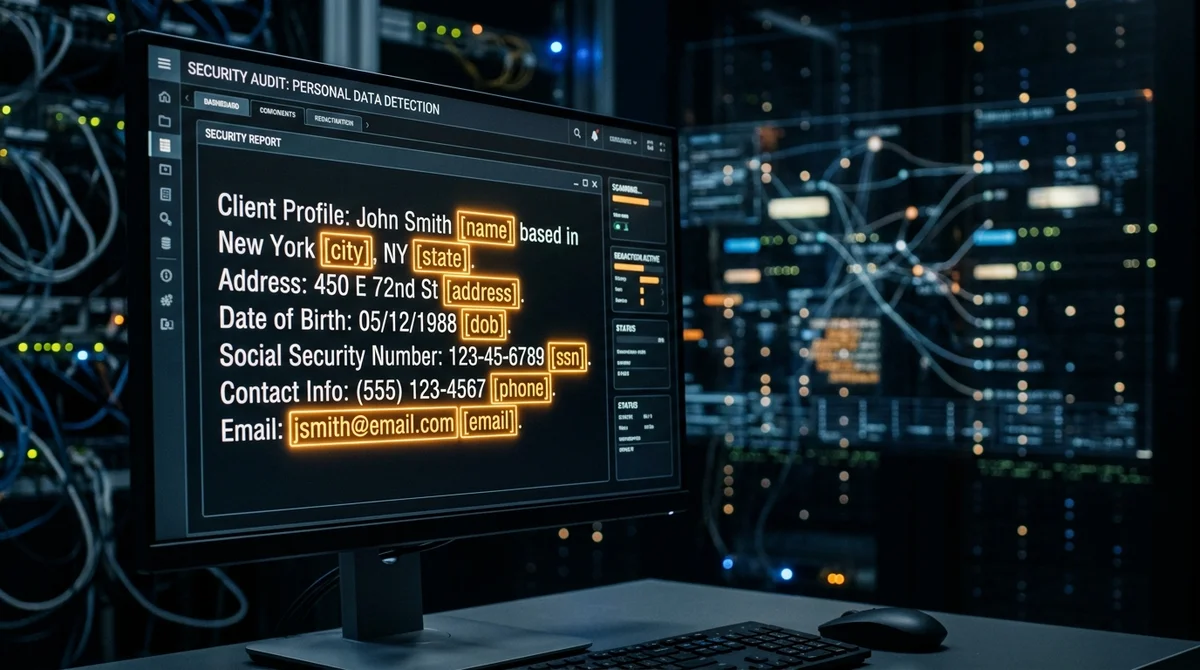
OpenAI has published Privacy Filter, an open model built on a distilled decoder that finds and removes personally identifiable information (PII) from text. Although its weights total 1.5 billion parameters, only 50 million are active during inference, which lets it run directly in the browser with no server infrastructure.
What Privacy Filter is
Privacy Filter is a specialized language model built for one specific job: automatically detecting and redacting personally identifiable information (PII) in text. It is not a general-purpose chat assistant but a utility tool, focused solely on finding sensitive information and replacing it with standardized placeholders.
The specialization is an advantage: a narrowly tuned model handles the task better than general-purpose LLMs, which often miss unusually phrased personal data or make mistakes in complex contexts.
The model is based on a distilled decoder: a large teacher model passes its knowledge to a compact student model through distillation. The result is high detection accuracy with significantly lower compute requirements. The model is openly available, so any company can build it into its own pipelines without sending data to OpenAI's servers.
Architecture: 50 million out of 1.5 billion
The key technical detail is the gap between the total parameter count (1.5 billion) and the parameters actually activated for each token (50 million). This approach is typical of sparse-activation architectures: different neural blocks specialize in different aspects of the task and switch on selectively, depending on the input.
That makes Privacy Filter practical in resource-constrained scenarios:
- Browser: compatible with WebAssembly and ONNX, so data never leaves the user's device
- Edge devices: 50M active parameters allow it to run without a GPU on laptops and smartphones
- Self-hosted: the model fits entirely inside a company's own infrastructure
- CI/CD pipelines: fast inference with no cloud dependencies and no extra costs
What it can detect
Privacy Filter recognizes a broad set of personal data categories, covering key requirements of GDPR, LGPD and CCPA:
- Names, surnames, initials (including contextual recognition without explicit markers)
- Addresses, postal codes, geographic coordinates
- Phone numbers and email addresses
- Identity documents: passports, SSNs, INN (Russian tax ID numbers), driver's licenses
- Financial data: card and bank account numbers
- Medical identifiers
The model does not just flag PII fragments; it also replaces them with standard placeholders: [NAME], [ADDRESS], [PHONE]. The output text is immediately ready for further processing with no manual post-processing.
Regulatory context
Regulatory pressure on personal data is growing worldwide. GDPR in Europe, LGPD in Brazil and CCPA in California all require companies to handle sensitive information carefully. Most commercial automatic anonymization solutions either fell short on quality or required sending data to the cloud, which itself undermined the point of confidentiality.
Privacy Filter fills that gap: an open model with browser compatibility that a small team can build into a product in a day without sacrificing user privacy.
What this means
OpenAI keeps investing in open infrastructure alongside its commercial flagships. Privacy Filter shows that the company sees a market not only in API access to GPT but also in utility tools that address specific operational needs. It signals that enterprise-grade open-source tools for AI data security are becoming the norm.
For businesses, it is a ready-made solution to the anonymization problem, with no need to build from scratch and no dependence on the cloud.
- Nov 2, 2026Arca gives AI agents finance tasks lasting up to 10 days, but leaves the trades to humans
- Nov 2, 2026Meta's Muse assistant keeps dossiers on loved ones and gets root on Ubuntu by default
- Nov 1, 2026Local models lose to Opus and Codex: 0.21 on a MacBook versus 1.00 for Codex
- Nov 1, 2026Kimi scores 96.2% on a 1C database analytics test and emerges as a fallback if Claude access is blocked
Key Questions Answered
What Privacy Filter is?
Privacy Filter is a specialized language model built for one specific job: automatically detecting and redacting personally identifiable information (PII) in text. It is not a general-purpose chat assistant but a utility tool, focused solely on finding sensitive information and replacing it with standardized placeholders. The specialization is an advantage: a narrowly tuned model handles the task better than general-purpose LLMs, which often miss unusually phrased personal data or make mistakes in complex contexts. The model is based on a distilled decoder: a large teacher
What are the key details on Architecture: 50 million out of 1.5 billion?
The key technical detail is the gap between the total parameter count (1.5 billion) and the parameters actually activated for each token (50 million). This approach is typical of sparse-activation architectures: different neural blocks specialize in different aspects of the task and switch on selectively, depending on the input. That makes Privacy Filter practical in resource-constrained scenarios: Browser: compatible with WebAssembly and ONNX, so data never leaves the user's device Edge devices: 50M active parameters allow it to run without a GPU on laptops and smartphones
What it can detect?
Privacy Filter recognizes a broad set of personal data categories, covering key requirements of GDPR, LGPD and CCPA: Names, surnames, initials (including contextual recognition without explicit markers) Addresses, postal codes, geographic coordinates Phone numbers and email addresses Identity documents: passports, SSNs, INN (Russian tax ID numbers), driver's licenses Financial data: card and bank account numbers Medical identifiers The model does not just flag PII fragments; it also replaces them with standard placeholders: [NAME], [ADDRESS], [PHONE]. The output text is imm
Test Frontier LLMs & Autonomous Agents in One Workspace
Run Claude Opus 5.5, GPT-6, Gemini 3.1, and DeepSeek side-by-side in Nomad AI (nomadnet.ai) — unified model routing, deep research, and multimodal workflows under one subscription.
The AI world, distilled — once a week
Seven stories that actually mattered, hand-picked. No noise, no reposts, no press releases.
Done! Check your inbox for a confirmation.