Auburn University launches AI cafés for talking about AI without panic or jargon
Auburn University came up with a simple format for talking about AI: the AI café, held in a coffee shop with no lectures and no jargon. Students, faculty and local residents discussed how AI screening in job interviews, automation and platforms are already changing work, education and the sense of being in control. The main takeaway: people don't want to slow AI down. They want to influence what it becomes.
AI-processed from IEEE Spectrum AI; edited by Hamidun News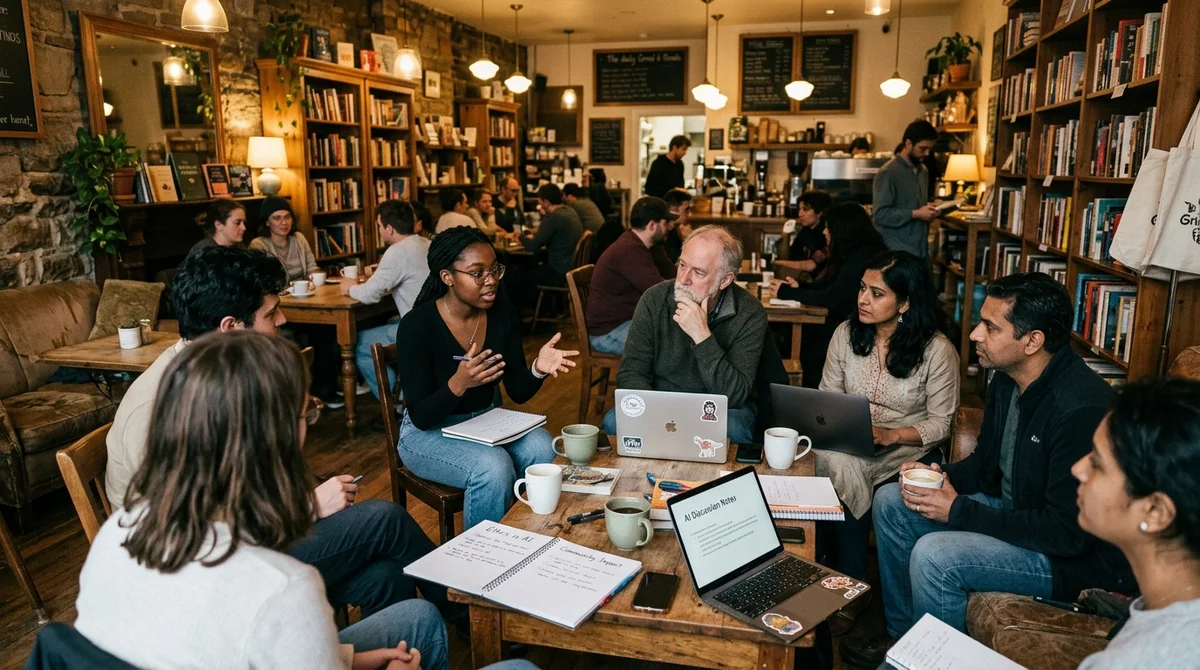
In Auburn, Alabama, faculty at the local university ran open AI cafés. They were not lectures about technology but honest conversations about anxieties surrounding AI. The format was simple, yet it showed something important: people are ready to discuss artificial intelligence in concrete terms, as long as nobody talks down to them.
How the format worked
The AI café took place in an ordinary coffee shop and a bookstore. Faculty, students and townspeople sat at tables together, and each meeting lasted about 90 minutes. The organizers deliberately dropped the academic tone: less jargon, fewer attempts to "fix" other people's fears, more concrete stories from everyday life. Instead of debating superintelligence, they asked participants where exactly they already run into AI: when job hunting, at school, on social media, in recommendation services and in office tools.
According to the organizers, several simple rules worked best. They don't require a big budget, but they change the quality of the conversation significantly: people join in faster, share personal experience more willingly and drift less often into abstract arguments about the distant future. Historical analogies helped too: the printing press, electricity, smartphones. Through them, participants found it easier to understand their own reaction to a new technology and not reduce the conversation to science fiction.
- Not an audience and a stage, but circles around small tables
- Not abstract "AI in general", but specific tools and scenarios
- Not a debate about the future 20 years out, but a conversation about what is happening now
- Not an expert's position from above, but a joint review of the changes
- Not a one-off event, but a series of meetings that build trust
Another important lesson turned out to be unexpectedly practical: without a shared definition of AI, people often discuss different things and quickly start talking past each other. For some, AI means ChatGPT and text generation; for others, feed algorithms, surveillance cameras, recommendation systems or automated résumé screening. So the organizers asked participants to name not "AI in general" but the specific tools and situations that worry them or, conversely, help them at work and in school.
What people said
The strongest theme was not "fear of machines" but a sense of losing control. Participants said technology is increasingly deployed to serve the goals of companies, not society. Students feel this especially sharply: if employers use AI screening, teams are shrinking and companies are pouring billions into infrastructure, it's unclear what the job market will look like by the time they graduate. Against that backdrop, questions like "Will I get an interview?" and "Will I be able to find a job after university?" sounded not like panic but like a normal reaction to rapid change.
"Without regard for public needs."
Once people were allowed to speak their minds without condescension, the tone of the conversation shifted noticeably. Instead of a demand to "stop AI", a more mature position emerged: development will continue, but society wants a say in choosing the rules. The meetings produced down-to-earth priorities: fairness matters more than raw efficiency, dignity more than convenience, creativity more than blind automation, and community interests more than an individualistic race for productivity. The organizers learned something too: they saw how AI already affects work, children's education and trust in information.
How to repeat the idea
The organizers believe universities, professional communities and city venues should launch similar dialogues of their own. The logic is simple: the conversation about responsible AI should not remain an internal matter for engineers or big tech companies. Ethics codes look good on paper, but without talking to the people affected by new systems, they quickly become a formality. And there is no universal recipe: expectations of AI in one city, industry or country can differ markedly from those elsewhere.
The practical lesson from Auburn University's experience: start not by explaining the model but by talking about values. What world do people want to preserve? Where does AI really help? Where does it amplify inequality, pressure or alienation? Moderation matters too: don't let the discussion drift into science fiction, bring it back to current experience, ask follow-up questions and turn anxiety into a discussion of solutions. Otherwise, responsibility for the trajectory of the technology quietly passes to a narrow circle of specialists, and society once again gets changes that happen to it rather than with it.
What this means
The AI café story shows that the main deficit around AI today is not only technical but also social. People don't need yet another pitch about a model's capabilities. They need a space where they can name risks, agree on priorities and regain the right to influence how technology enters everyday life.
- Nov 2, 2026Arca gives AI agents finance tasks lasting up to 10 days, but leaves the trades to humans
- Nov 2, 2026Meta's Muse assistant keeps dossiers on loved ones and gets root on Ubuntu by default
- Nov 1, 2026Local models lose to Opus and Codex: 0.21 on a MacBook versus 1.00 for Codex
- Nov 1, 2026Kimi scores 96.2% on a 1C database analytics test and emerges as a fallback if Claude access is blocked
Key Questions Answered
How the format worked?
The AI café took place in an ordinary coffee shop and a bookstore. Faculty, students and townspeople sat at tables together, and each meeting lasted about 90 minutes. The organizers deliberately dropped the academic tone: less jargon, fewer attempts to "fix" other people's fears, more concrete stories from everyday life. Instead of debating superintelligence, they asked participants where exactly they already run into AI: when job hunting, at school, on social media, in recommendation services and in office tools. According to the organizers, several simple rules worked bes
What people said?
The strongest theme was not "fear of machines" but a sense of losing control. Participants said technology is increasingly deployed to serve the goals of companies, not society. Students feel this especially sharply: if employers use AI screening, teams are shrinking and companies are pouring billions into infrastructure, it's unclear what the job market will look like by the time they graduate. Against that backdrop, questions like "Will I get an interview?" and "Will I be able to find a job after university?" sounded not like panic but like a normal reaction to rapid chan
How to repeat the idea?
The organizers believe universities, professional communities and city venues should launch similar dialogues of their own. The logic is simple: the conversation about responsible AI should not remain an internal matter for engineers or big tech companies. Ethics codes look good on paper, but without talking to the people affected by new systems, they quickly become a formality. And there is no universal recipe: expectations of AI in one city, industry or country can differ markedly from those elsewhere. The practical lesson from Auburn University's experience: start not by
Test Frontier LLMs & Autonomous Agents in One Workspace
Run Claude Opus 5.5, GPT-6, Gemini 3.1, and DeepSeek side-by-side in Nomad AI (nomadnet.ai) — unified model routing, deep research, and multimodal workflows under one subscription.
The AI world, distilled — once a week
Seven stories that actually mattered, hand-picked. No noise, no reposts, no press releases.
Done! Check your inbox for a confirmation.