Nvidia restarts H200 production for China after export-license pause
Nvidia has restarted production of the H200 for the Chinese market after a pause caused by the lack of export licenses. That clears the way to resume deliveries to local customers and sends the market a clear signal: even with strong demand for AI accelerators, the binding constraint is not fab capacity but regulatory decisions. For Chinese buyers, it is a chance to plan purchases again without total uncertainty.
AI-processed from CNews AI; edited by Hamidun News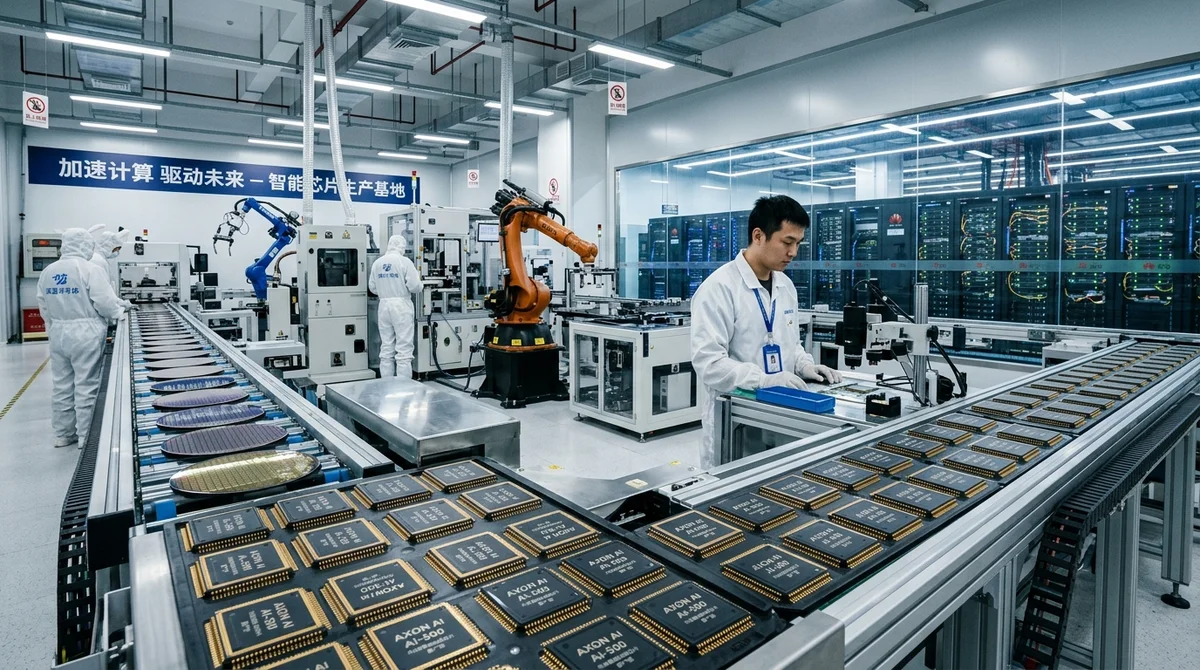
Nvidia is again producing H200 AI chips for the Chinese market. Production and shipments had to be paused because of missing export licenses, without which the company could not resume deliveries to Chinese customers.
Why the H200 is back
The restart matters not only to Nvidia but to the entire AI-hardware supply chain in China. The H200 belongs to the class of accelerators around which compute clusters for training and running large models are built. When output of such a product stops not for technical reasons but because of regulatory barriers, purchases, deployment timelines and data-center plans are put in doubt for months ahead.
For Nvidia itself, it is also a way to restore predictability in its relationship with a large market where demand for AI compute remains high. If the company is again producing the H200 for Chinese shipments, it means a working route has emerged between the production plan and export approval. This does not remove the restrictions, but it reduces uncertainty for partners, integrators and end enterprise customers. For the market, that is already a noticeable shift.
What changes now
Resuming production does not mean the Chinese market will instantly receive all the volume it needs. But it restores the main thing: the ability to plan purchases again without complete uncertainty. For cloud platforms, model developers and corporate IT teams this is critical, because AI infrastructure is not bought on impulse. It is designed in advance, with budgets, electricity, racks, networking equipment and staff reserved for it. That is why even a partial recovery of supply changes the market's tone.
- Clearer delivery timelines for new purchases
- Fewer pauses in launching AI clusters
- More confidence among integrators and cloud providers
- The ability not to postpone infrastructure upgrades
In practical terms, it also eases pressure on customers who had been forced to look for workarounds: pushing back deadlines, changing server configurations or redistributing workloads among accelerators they already had. The longer the supply pause lasts, the more expensive waiting becomes. So the mere fact that the H200 is back on the production schedule matters even before actual batches reach customers.
For many teams, it is a signal to reopen frozen plans. It lowers the cost of waiting and eases tension in talks with internal teams and investors.
The restrictions have not gone away
The key reason for the earlier halt has not disappeared: the issue was not weak demand or production problems, but export licenses. That means the whole arrangement still depends on the regulatory regime. Even after the restart, the company remains in a situation where product availability is determined not only by the factory cycle and logistics but also by external permissions. For customers, this is still a risk factor.
A broader conclusion follows for the AI-hardware market. Even the largest accelerator supplier cannot treat shipments to sensitive regions as a purely commercial task. For buyers, this is a reason to diversify their plans, think through fallback configurations in advance, and not build critical roadmaps around a single chip model, however in-demand it is. The market is thus becoming more cautious and pragmatic in the near term as well.
What this means
The H200 restart for China shows that demand for AI accelerators remains strong enough for Nvidia to return to this business as soon as a regulatory window opens. But the news matters for another reason: in AI infrastructure today, the winner is not only whoever has the faster chip but whoever's supply is less exposed to a sudden pause. For business, this means one thing: an AI-hardware procurement strategy is now as important as the choice of model and budget.
- Nov 2, 2026TensorFold 1.2.0 boosts Qwen3.8-27B throughput on M3 Ultra by 44.2% at 16 streams
- Nov 1, 2026Local models lose to Opus and Codex: 0.21 on a MacBook versus 1.00 for Codex
- Nov 1, 2026Habr author fine-tunes YOLOv8l on dental X-rays and pushes mAP50 to 0.642
- Nov 1, 2026Voice bots built on LLMs turn to Jev, a fast classifier, for decisions in 200–500 ms
Key Questions Answered
Why the H200 is back?
The restart matters not only to Nvidia but to the entire AI-hardware supply chain in China. The H200 belongs to the class of accelerators around which compute clusters for training and running large models are built. When output of such a product stops not for technical reasons but because of regulatory barriers, purchases, deployment timelines and data-center plans are put in doubt for months ahead. For Nvidia itself, it is also a way to restore predictability in its relationship with a large market where demand for AI compute remains high. If the company is again producin
What changes now?
Resuming production does not mean the Chinese market will instantly receive all the volume it needs. But it restores the main thing: the ability to plan purchases again without complete uncertainty. For cloud platforms, model developers and corporate IT teams this is critical, because AI infrastructure is not bought on impulse. It is designed in advance, with budgets, electricity, racks, networking equipment and staff reserved for it. That is why even a partial recovery of supply changes the market's tone. Clearer delivery timelines for new purchases Fewer pauses in launchi
What are the key details on The restrictions have not gone away?
The key reason for the earlier halt has not disappeared: the issue was not weak demand or production problems, but export licenses. That means the whole arrangement still depends on the regulatory regime. Even after the restart, the company remains in a situation where product availability is determined not only by the factory cycle and logistics but also by external permissions. For customers, this is still a risk factor. A broader conclusion follows for the AI-hardware market. Even the largest accelerator supplier cannot treat shipments to sensitive regions as a purely co
Test Frontier LLMs & Autonomous Agents in One Workspace
Run Claude Opus 5.5, GPT-6, Gemini 3.1, and DeepSeek side-by-side in Nomad AI (nomadnet.ai) — unified model routing, deep research, and multimodal workflows under one subscription.
The AI world, distilled — once a week
Seven stories that actually mattered, hand-picked. No noise, no reposts, no press releases.
Done! Check your inbox for a confirmation.