Pentagon Plans Secure Environments to Train AI Models on Classified Data
The Pentagon wants to go beyond simply running chatbots on classified networks and allow military versions of models to be fine-tuned on classified data. The scheme under discussion involves accredited data centers, with the Defense Department retaining rights to the data and vendor employees getting access only rarely, and only with a security clearance. If the plan is approved, AI would become even more deeply embedded in intelligence work and military analysis.
AI-processed from MIT Technology Review; edited by Hamidun News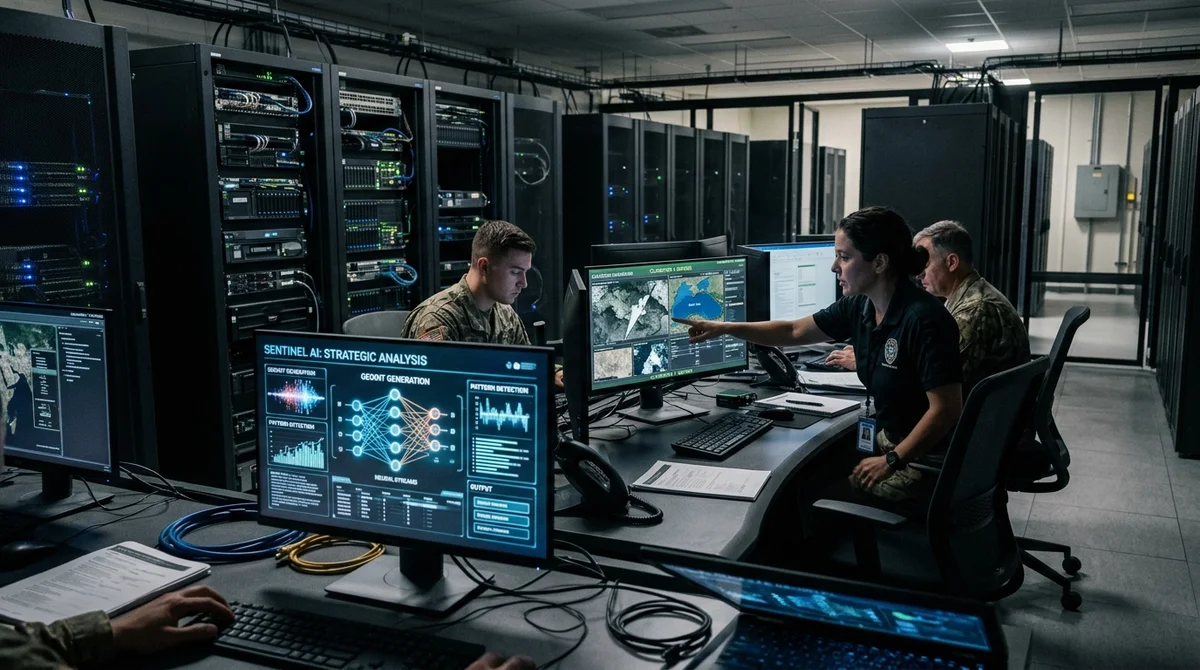
The Pentagon is discussing the next step in the military use of generative AI: not just running models on classified networks, but training them on classified data. If the plan is approved, AI companies will be able to fine-tune special military versions of their systems inside secure US Department of Defense environments.
What is changing now
Large models already run in classified environments and answer user questions, but they do not "learn" from the classified datasets themselves. Such systems have already been used in tasks related to target analysis in Iran.
The new plan changes the underlying logic. Instead of temporary access to documents and briefings, the Pentagon wants to enable separate versions of models with military knowledge built in at the training level.
This is an important threshold for generative AI in defense. Earlier contracts of this kind mostly involved narrower computer vision models or data that commercial contractors could already access. Now the aim is to feed intelligence reports, satellite observations, field assessments and other sensitive materials into the model. In theory, this should make AI answers more accurate, because the system would not have to rely only on publicly available data and external search over closed documents.
How the training would work
As currently discussed, training would take place not at vendors in an ordinary cloud, but in accredited data centers cleared to work on classified US projects. The Pentagon would retain ownership of the data, and copies of the needed models would be loaded inside the perimeter.
For AI companies, this means a tightly restricted way of working: in rare cases, employees may be given access to classified information, but only after obtaining the appropriate clearance. Before moving to classified datasets, the military wants to test the scheme on unclassified data, such as commercial satellite imagery.
- Separate military versions of models would be fine-tuned, not public products
- Training should take place in certified secure environments
- The Pentagon would remain the owner of the source data
- Vendor employees' access to classified information is planned as an exception, not the norm
This approach gives the Pentagon a more specialized tool without handing a raw mass of intelligence data to commercial infrastructure. It also lowers the political risk for contractors: formally, they do not take classified datasets away, but work inside a government environment. But it does not resolve a harder question: what happens when sensitive information ends up not in files, but in the weights of the model itself.
The main risks of the scheme
The main problem is that a model trained on classified data may reveal knowledge too broadly. AI policy experts warn that if the same tool starts being used by different Defense Department units, a user without the necessary clearance level could get an answer based on information above their clearance.
In classical databases, access rights can be strictly separated by document. With a language model, such control is much harder, because information is distributed across internal parameters rather than stored in one separate file.
There is a second risk: defense customers may start relying on the system where the cost of error is too high. The deeper a model is embedded in target analysis, strike prioritization or intelligence assessment, the harder it is to see it as an ordinary search interface. Even if the final decision remains with a human, AI begins to influence which options reach an officer's desk at all, and in what order they are considered. That is why the debate over such models quickly goes beyond infrastructure and comes down to the rules governing the use of force.
What this means
The Pentagon wants to move from using other companies' chatbots on a closed network to building its own military versions of models trained on classified information. If the plan is carried out, the defense AI market will move sharply toward a new standard: a model's value will be measured not only by its general capabilities, but by the depth of its access to a state's classified data.
- Oct 31, 2026Author puts his script before an AI jury: the verdict cost 850 thousand tokens
- Oct 31, 2026SciGame Tests Five LLM Agents: Familiar Formulas Get in the Way of Finding Altered Laws
- Oct 30, 2026Agent traffic on Zocdoc is up 30x since July, and ChatGPT faces two health lawsuits
- Oct 29, 2026OvisOCR3: an 0.8B-parameter model that reads documents better than specialized systems
Key Questions Answered
What is changing now?
Large models already run in classified environments and answer user questions, but they do not "learn" from the classified datasets themselves. Such systems have already been used in tasks related to target analysis in Iran. The new plan changes the underlying logic. Instead of temporary access to documents and briefings, the Pentagon wants to enable separate versions of models with military knowledge built in at the training level. This is an important threshold for generative AI in defense. Earlier contracts of this kind mostly involved narrower computer vision models or
How the training would work?
As currently discussed, training would take place not at vendors in an ordinary cloud, but in accredited data centers cleared to work on classified US projects. The Pentagon would retain ownership of the data, and copies of the needed models would be loaded inside the perimeter. For AI companies, this means a tightly restricted way of working: in rare cases, employees may be given access to classified information, but only after obtaining the appropriate clearance. Before moving to classified datasets, the military wants to test the scheme on unclassified data, such as comm
What are the key details on The main risks of the scheme?
The main problem is that a model trained on classified data may reveal knowledge too broadly. AI policy experts warn that if the same tool starts being used by different Defense Department units, a user without the necessary clearance level could get an answer based on information above their clearance. In classical databases, access rights can be strictly separated by document. With a language model, such control is much harder, because information is distributed across internal parameters rather than stored in one separate file. There is a second risk: defense customers m
Test Frontier LLMs & Autonomous Agents in One Workspace
Run Claude Opus 5.5, GPT-6, Gemini 3.1, and DeepSeek side-by-side in Nomad AI (nomadnet.ai) — unified model routing, deep research, and multimodal workflows under one subscription.
The AI world, distilled — once a week
Seven stories that actually mattered, hand-picked. No noise, no reposts, no press releases.
Done! Check your inbox for a confirmation.