Overworld releases Waypoint-1.5: interactive 720p worlds on consumer GPUs
Overworld has unveiled Waypoint-1.5, a new world model for interactive generated worlds. The main update is two model versions: up to 720p at 60 FPS on desktop RTX 3090–5090 cards, and a separate 360p mode for more mainstream hardware. It was trained on nearly 100 times more data than Waypoint-1, which should yield more coherent scenes and steadier motion. Overworld also offers a local client, a browser-based option and an open inference library for outside developers.
AI-processed from Hugging Face Blog; edited by Hamidun News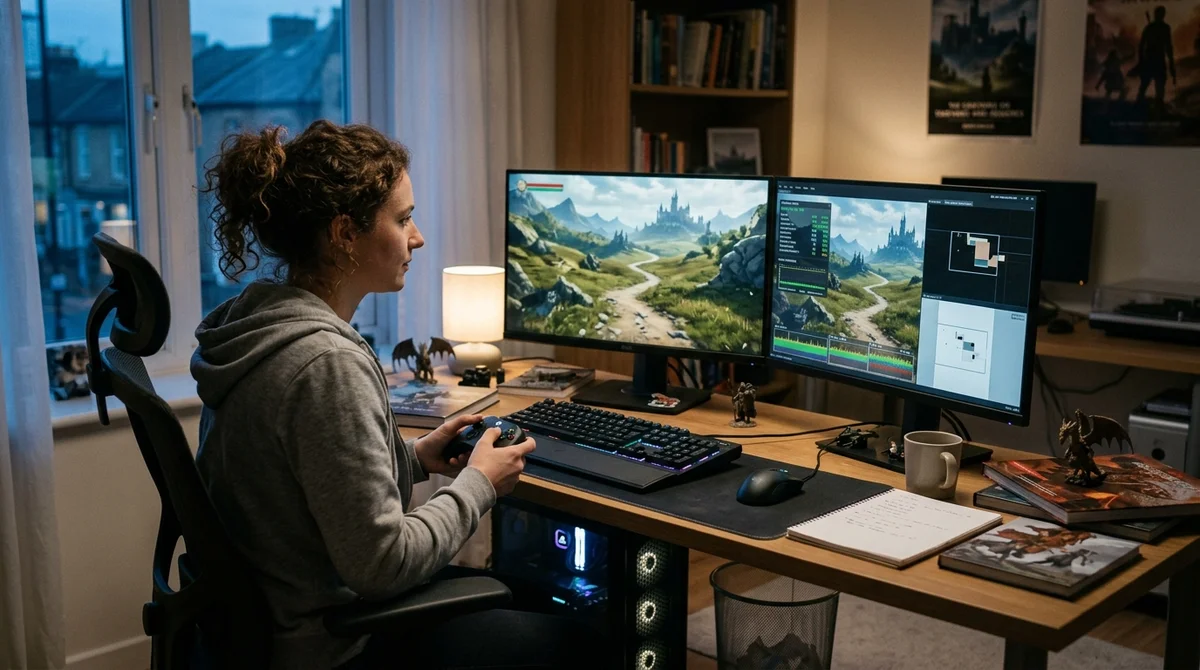
Overworld has released Waypoint-1.5, a new version of its real-time world model that generates interactive environments locally on users' own GPUs. The update focuses not only on image quality but also on responsiveness: the model can run at up to 720p and 60 FPS on desktop RTX 3090–5090 cards, and it adds a lighter mode for mainstream hardware.
A new level of quality
The first Waypoint was closer to a proof of concept: interactive generative worlds can be run in real time at all, rather than only shown as a pre-rendered clip. With version 1.5, the team went further and focused on making such scenes look more convincing in motion. It is not only about a nicer picture, but about how the world behaves when the user moves, changes direction or simply keeps exploring without pauses or loading.
The key change is the scale of training. According to Overworld, Waypoint-1.5 was trained on nearly 100 times more data than the dataset used for Waypoint-1. This should make environments more coherent and motion on screen steadier from moment to moment. In parallel, the team reworked video modeling for real time to cut redundant computation between neighboring frames. For a world model this is critical: users care not about the beauty of a single still frame, but about the feeling of a continuous, responsive space.
A bet on accessibility
The main idea of the release is not to lock the new model inside data centers or expensive server configurations. Overworld says outright that it is building Waypoint-1.5 for hardware people already have at home. So the release is split into two tiers: a heavier model for powerful desktop GPUs and a lighter variant for a wider audience. In essence, the team names accessibility as the main difference between 1.5 and the first iteration.
- the 720p version is designed for more powerful desktop graphics cards
- up to 60 FPS is claimed on systems with RTX 3090–5090
- a separate 360p model is optimized for more mainstream PCs and gaming laptops
- Apple Silicon Mac support is announced as the next expansion
- the emphasis is on local execution without a compute cluster
This approach matters for a simple reason: an interactive world feels alive only if it responds instantly. If such systems require a remote GPU cluster, they remain impressive demos. If the model runs locally on an ordinary gaming computer, more practical use cases open up, from experimental games and interactive storytelling to creative tools and simulations that can be deployed without complex infrastructure. And the lower the barrier to entry, the faster an ecosystem forms around such models.
How to run the model
Waypoint-1.5 has two usage paths. The first is a local run through the Overworld Biome client. Its runtime has been updated and installation simplified: the team promises that going from download to first launch now takes minutes rather than a long manual environment setup. This detail matters because many interesting AI systems lose their audience not because of quality, but because of overly fragile and complicated onboarding. Overworld is clearly trying to remove exactly that barrier.
The second option is Overworld Stream, where you can try the model right in the browser with no local installation. This mode is useful for anyone who wants to judge the quality quickly before spending time on setup at home.
Separately, Overworld is releasing World Engine, the base inference library that powers the official clients and almost a dozen third-party clients and libraries. In other words, the company is offering not just a demo but a foundation for outside developers who want to build their own interfaces and scenarios on top of the model.
What this means
Waypoint-1.5 shows an important shift in the world-model market: the race is no longer only about photorealism, but about a combination of quality, speed and local availability. If this approach takes hold, interactive generative worlds will move faster from spectacular experiments into ordinary consumer software.
- Nov 2, 2026TensorFold 1.2.0 boosts Qwen3.8-27B throughput on M3 Ultra by 44.2% at 16 streams
- Nov 1, 2026Local models lose to Opus and Codex: 0.21 on a MacBook versus 1.00 for Codex
- Oct 29, 2026Claude Code Edits Video From a Transcript: How the video-use Skill With 30 000 Stars Works
- Oct 29, 2026Stanford AI tool verifies part of Signal's code in half a day for under $500, versus five months of expert work
Key Questions Answered
What are the key details on A new level of quality?
The first Waypoint was closer to a proof of concept: interactive generative worlds can be run in real time at all, rather than only shown as a pre-rendered clip. With version 1.5, the team went further and focused on making such scenes look more convincing in motion. It is not only about a nicer picture, but about how the world behaves when the user moves, changes direction or simply keeps exploring without pauses or loading. The key change is the scale of training. According to Overworld, Waypoint-1.5 was trained on nearly 100 times more data than the dataset used for Wayp
What are the key details on A bet on accessibility?
The main idea of the release is not to lock the new model inside data centers or expensive server configurations. Overworld says outright that it is building Waypoint-1.5 for hardware people already have at home. So the release is split into two tiers: a heavier model for powerful desktop GPUs and a lighter variant for a wider audience. In essence, the team names accessibility as the main difference between 1.5 and the first iteration. the 720p version is designed for more powerful desktop graphics cards up to 60 FPS is claimed on systems with RTX 3090–5090 a separate 360p
How to run the model?
Waypoint-1.5 has two usage paths. The first is a local run through the Overworld Biome client. Its runtime has been updated and installation simplified: the team promises that going from download to first launch now takes minutes rather than a long manual environment setup. This detail matters because many interesting AI systems lose their audience not because of quality, but because of overly fragile and complicated onboarding. Overworld is clearly trying to remove exactly that barrier. The second option is Overworld Stream, where you can try the model right in the browser
Test Frontier LLMs & Autonomous Agents in One Workspace
Run Claude Opus 5.5, GPT-6, Gemini 3.1, and DeepSeek side-by-side in Nomad AI (nomadnet.ai) — unified model routing, deep research, and multimodal workflows under one subscription.
The AI world, distilled — once a week
Seven stories that actually mattered, hand-picked. No noise, no reposts, no press releases.
Done! Check your inbox for a confirmation.