TAPe unveils compact object detector as an alternative to YOLO for custom tasks
The TAPe team has described a pilot model for object detection on COCO-like data. Instead of a pixel grid, the approach works with meaningful image regions and lets customers add their own classes. On a small dataset, a detector with roughly 115K parameters hit 98.94% on an applied metric, and on a COCO subset it reached 60.59%. It did so without augmentations and with training on a CPU.
AI-processed from Habr AI; edited by Hamidun News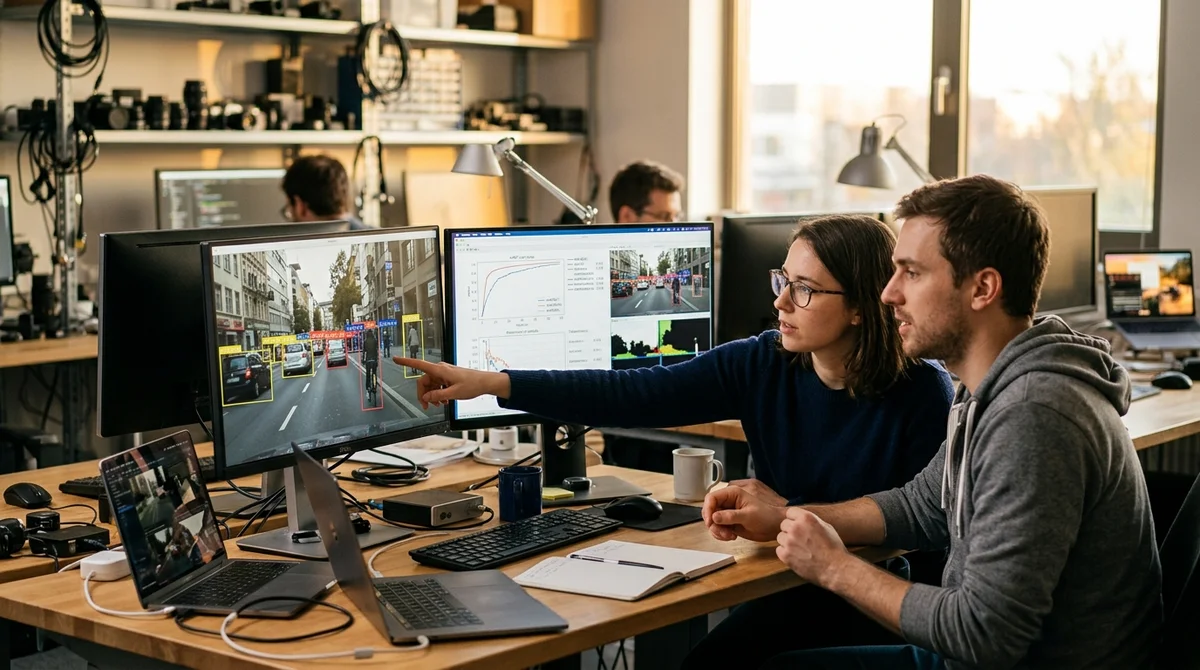
TAPe has published a working FAQ for its object detector and shared early results on a small dataset and a COCO subset. The project does not yet call this a full academic benchmark, but the numbers look strong enough for engineers and researchers to start paying attention.
How TAPe works
The approach does not work with pixels or a rigid N×N grid, as classic YOLO pipelines do. It works with meaningful image regions. TAPe operates on patches in its own data representation and tries to discard clearly empty or irrelevant areas in a single pass, keeping only the zones where it makes sense to look for an object.
This matters not only for speed but also for tuning to applied tasks. The team built the system from the start for COCO-like data, with the ability to add custom classes and fine-tune the solution for a specific customer. As it evolved, the architecture moved away from a heavier dictionary scheme to a compact configuration in which class descriptions are assembled from TAPe vectors and compressed with k-means, rather than trained as a separate neural network through classic gradient descent.
What the pilot showed
The team got its first results on a small dataset of four classes and 1256 images with partly noisy annotation. On this set, the pilot TAPe detector, at about 115 thousand parameters, hit 98.94% of objects on an applied metric: the centroid of the predicted box must fall within 32 pixels of the center of the ground-truth annotation. The authors stress that the model was trained on a CPU and without augmentations, a setup that usually does not look favorable for detection.
- 4 classes and 1256 images
- Partly noisy annotation
- About 115 thousand parameters
- CPU training without augmentations
- 98.94% hits on the applied metric
As a baseline, the authors used YOLO11s from the Ultralytics lineup. On the same dataset, by their account, that model converged worse, detected less well and produced noticeably more false positives. The authors themselves do not try to declare victory early.
"It is too early to draw conclusions."
On a COCO subset of about 2% of the dataset, roughly 2400 images, the same compact scheme without special optimizations reached 60.59% hits on object centers. For such a small detector this looks surprisingly strong, and it is essentially the main argument for the TAPe representation itself.
Why it matters
The main point is not that yet another detector has appeared, but that the team is trying to change the level at which the model works with an image. Most popular approaches are still tied to pixels, dense feature maps and fairly heavy optimization. TAPe proposes first structuring the scene into more meaningful regions and only then deciding on detection. If this principle really carries over to different datasets, it may prove more useful than the first numbers suggest.
There is also a purely practical side. For enterprise and industrial scenarios, leaderboard records often matter less than the ability to add a new class quickly, train on a small dataset and get a working result without expensive infrastructure. Here TAPe looks especially interesting: a small model, CPU training and early robustness to noisy annotation make a very clear set of arguments for an applied team.
The current demonstration has plenty of limitations, though. The authors say outright that the text does not replace formal benchmarks on COCO-like datasets. There is no full academic comparison on standard metrics such as mAP, no broad set of independent tests, and no grounds to believe TAPe is ready to displace YOLO in production. But as a technical signal it is a strong publication: it shows that an alternative form of data representation can deliver a surprisingly high result even with a very compact model.
What it means
If upcoming benchmarks confirm these early results, TAPe could become a notable alternative to YOLO-style approaches in custom object detection, especially where small models, fast addition of new classes and training without a heavy GPU stack matter.
Key Questions Answered
How TAPe works?
The approach does not work with pixels or a rigid N×N grid, as classic YOLO pipelines do. It works with meaningful image regions. TAPe operates on patches in its own data representation and tries to discard clearly empty or irrelevant areas in a single pass, keeping only the zones where it makes sense to look for an object. This matters not only for speed but also for tuning to applied tasks. The team built the system from the start for COCO-like data, with the ability to add custom classes and fine-tune the solution for a specific customer. As it evolved, the architecture
What the pilot showed?
The team got its first results on a small dataset of four classes and 1256 images with partly noisy annotation. On this set, the pilot TAPe detector, at about 115 thousand parameters, hit 98.94% of objects on an applied metric: the centroid of the predicted box must fall within 32 pixels of the center of the ground-truth annotation. The authors stress that the model was trained on a CPU and without augmentations, a setup that usually does not look favorable for detection. 4 classes and 1256 images Partly noisy annotation About 115 thousand parameters CPU training without au
Why it matters?
The main point is not that yet another detector has appeared, but that the team is trying to change the level at which the model works with an image. Most popular approaches are still tied to pixels, dense feature maps and fairly heavy optimization. TAPe proposes first structuring the scene into more meaningful regions and only then deciding on detection. If this principle really carries over to different datasets, it may prove more useful than the first numbers suggest. There is also a purely practical side. For enterprise and industrial scenarios, leaderboard records ofte
Test Frontier LLMs & Autonomous Agents in One Workspace
Run Claude Opus 5.5, GPT-6, Gemini 3.1, and DeepSeek side-by-side in Nomad AI (nomadnet.ai) — unified model routing, deep research, and multimodal workflows under one subscription.
The AI world, distilled — once a week
Seven stories that actually mattered, hand-picked. No noise, no reposts, no press releases.
Done! Check your inbox for a confirmation.