ZDNet AI
AI news source. Articles are auto-selected and adapted by Hamidun News editors.
Latest publications

ChatGPT can now search for movies and TV shows on Tubi: a free catalog of 300,000 titles
ChatGPT has received an integration with Tubi and can now recommend movies and TV shows from the streaming service’s free catalog, which includes more than 300,000 titles and episodes.

Google updated AI Mode in Search: results now open alongside and reduce tab chaos
Google changed AI Mode in Search: results users open are now shown next to the query window so they can read sources without extra switching and dozens of new tabs.

Linus Torvalds approved AI code rules for Linux: humans bear responsibility
Linux has officially allowed AI assistance in kernel development, but barred models from signing patches and placed all legal and technical responsibility on humans.

Google released Gemini for Mac: the native app is better than the website because it can access window contents
Gemini’s native Mac app turned out to be more useful than the web version: it analyzes the contents of a window shared from the desktop and answers right away based on the current document, email, spreadsheet, or note.

Cisco, PwC and Wyndham showed how they are actually retraining employees to work with AI
Amid talk of layoffs due to AI, some companies are betting not on cuts but on retraining: Cisco is rolling out mandatory courses, PwC is redefining roles, and Wyndham is speeding up service.

Hostinger became the leader among AI website builders, and the market finally matured in 2026
ZDNet updated its test of AI website builders and for the first time found them suitable for real work: Hostinger took the lead, and GoDaddy learned to edit CSS.

Google added Skills to Chrome for saving AI prompts and launching them in one click
Google launched Skills in Chrome, a Gemini feature that saves effective AI prompts, runs them on the current page and selected tabs, and lets users edit them for their own tasks.

Google released a Windows desktop app with quick access to Gemini and Lens
Google has made the Google app for desktop available to all Windows users: via Alt + Space, they can launch Gemini, Lens, web search, and file search without a browser.

McKinsey outlines four steps to scale agentic AI with high-quality data
McKinsey says AI agents cannot be scaled without four basic steps: choosing valuable workflows, upgrading the data architecture, ensuring data quality, and introducing governance.

ChatGPT and Perplexity can harm work and health with prolonged use
ZDNet warns that long sessions with AI chatbots increase the risk of mistakes, false confidence, and harmful decisions, so tasks should be strictly limited and responses should be checked.

Moonshot AI releases Kimi K2.6 — a model with a swarm of a thousand AI agents
Moonshot AI has launched Kimi K2.6, a model that can run up to a thousand parallel agents to tackle complex engineering tasks. The new approach could redefine AI-assisted development.

ChatGPT Images 2.0: a test of branding, text, and infographics — impressive, but not without errors
A ZDNet journalist tested ChatGPT Images 2.0 on real-world work tasks — branding, text, and infographics. The result is impressive, but with caveats.

Meta and OpenAI overpay for Moltbook and OpenClaw amid the agentic AI wave
ZDNet argues that Meta's Moltbook deal and OpenAI's hiring of OpenClaw's creator are a bet on hype: the products generate buzz, but are immature, insecure and no longer unique.

Karakeep helps organize articles, links, and YouTube tabs with AI
Karakeep turns the chaos of articles, research, and YouTube tabs into a tidy archive: AI automatically adds tags, creates brief summaries, and sorts everything by rules.

Nvidia added the NemoClaw security stack to OpenClaw for personal AI agents
Nvidia introduced NemoClaw for OpenClaw: the new stack runs agents in a sandbox, limits access to the network and files, and decides when to use local or cloud models.

Nvidia wants to cover the entire AI data center stack — from chips to networking and storage
At GTC 2026, Nvidia showed that it wants to sell companies not standalone GPUs, but an entire AI data center: compute, CPUs, networking, KV-cache storage, and software as a single system.

NVIDIA at GTC 2026 announced a 'ChatGPT moment' for self-driving cars and robots
At GTC 2026, NVIDIA said self-driving technology had reached a new milestone, expanded its robotaxi partnership with Uber, and updated its physical AI stack for robots, simulation, and training.
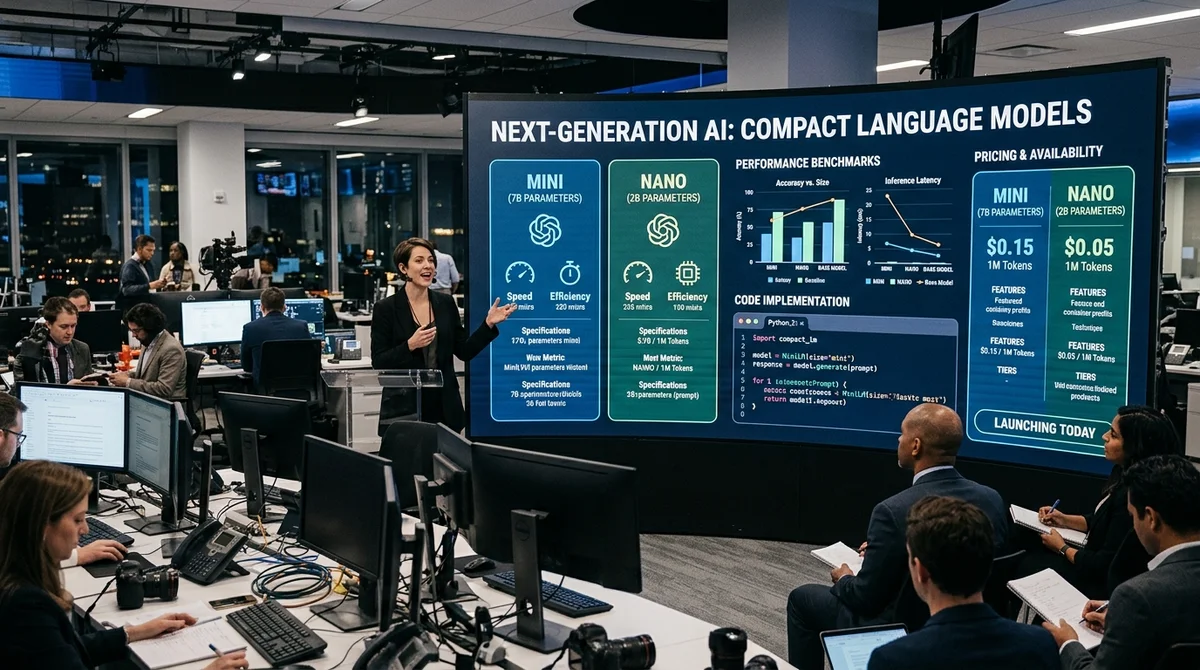
OpenAI Released GPT-5.4 Mini and Nano — Near-Flagship Quality at Lower Cost
OpenAI introduced compact models GPT-5.4 mini and nano: they run noticeably faster than the flagship version, but match it in quality on numerous benchmarks and cost significantly less.

OpenAI shows how ChatGPT Images 2.0 can redesign app interfaces
A journalist uploaded screenshots of two of his products to ChatGPT and received a UX analysis, new mockups, and ideas that can be passed almost immediately to a coding agent.

Anthropic launched Claude Security: AI service finds code vulnerabilities and suggests patches
Anthropic brought Claude Security to public beta: the Opus 4.7-based service scans repositories, reduces false positives, and suggests which vulnerabilities to fix first.

Anthropic adds auto mode to Claude Code: fewer confirmations and protection from dangerous commands
Anthropic introduced auto mode for Claude Code: the mode decides on some access requests, skips safe actions and blocks risky commands to avoid slowing down long tasks.

ChatGPT didn't kill the developer market: programmer numbers have grown significantly since 2022
After ChatGPT's launch, the number of developers in the US and worldwide did not decline but increased, while employer demand is shifting from routine coding to architecture, AI tools, and agent control.

Google simplified the transition to Gemini: you can transfer memory, chat history and settings
Google added to Gemini the ability to transfer memory, chat history and user preferences from other AI services so that new users wouldn't have to start from scratch.

Proton CEO: privacy in the age of AI is possible, but autonomous agents pose a new risk
Proton CEO Andy Yen believes that privacy in the age of AI can be preserved through local models and encryption, but he considers autonomous agents with access to personal data to be the most dangerous scenario.

Canonical Makes AI in Ubuntu Optional: Focusing on Local Models and User Control
Canonical unveiled its AI strategy for Ubuntu: local models by default, preview strictly opt-in, and the ability to skip agentic features if not needed.

Salesforce shows the future without screens: AI agents lead to disposable interfaces
Salesforce and WorkOS describe a shift from static screens to interfaces that AI assembles on the fly for a specific task, advising companies to build products around APIs, models, and data.

Google simplified the transition from ChatGPT to Gemini: now you can transfer memory and chats
Gemini has introduced a feature for importing memory, preferences, and chat history from ChatGPT and other AI services, so users can continue working without lengthy setup from scratch.

Cal.com moves core product to closed source over AI threats to open source
Cal.com is moving its commercial version to closed source, citing that AI tools discover vulnerabilities in public repositories too quickly, increasing risk to customer data.

OpenAI Turned Codex Desktop Into a PC Agent With Browser, Memory, and Plugins
OpenAI upgraded Codex Desktop: the agent now manages applications on your computer, operates in an embedded browser, retains context, and handles long-running automations.

Google enables Gemini to tap Gmail and Photos for more accurate, personalized answers
Google's Personal Intelligence feature in Gemini connects Gmail, Photos and other Google services, allowing the AI to understand context without lengthy prompts and provide more accurate, personalized answers.