Altman tells staff: OpenAI does not control the Pentagon's decisions
At an internal meeting, OpenAI CEO Sam Altman told employees that the company cannot and should not decide how the Pentagon uses its AI technology. Altman also hinted that rival Anthropic's push to control what the Defense Department does was one of the reasons for the tension between them. The statement reflects OpenAI's strategic turn toward military cooperation and raises the question of where AI developers' responsibility ends for the final use of their products.
AI-processed from Bloomberg Tech; edited by Hamidun News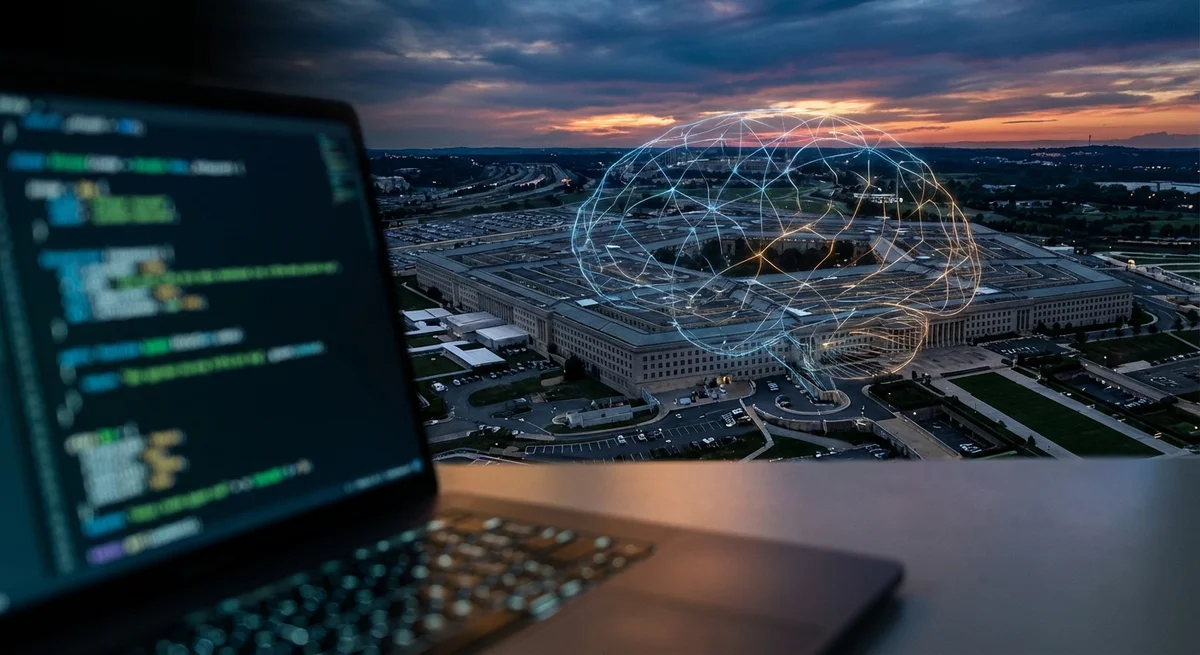
Sam Altman has drawn a line that many in the artificial intelligence industry long hesitated even to sketch. At an internal meeting with employees, the OpenAI chief said flatly that the company has no say in how the US Department of Defense handles its software. He went further, making clear that the very desire to control the Pentagon's actions may be a mistake already made by OpenAI's main rival, Anthropic.
The statement did not come out of nowhere. Over the past two years, Silicon Valley's relationship with the US military has changed radically. In 2018, thousands of Google employees signed a petition against Project Maven, a program that analyzed drone video for the Pentagon. By 2026, the mood in the industry has become unrecognizable. OpenAI, which not long ago presented itself as an organization with a mission of "safe AI for all humanity," has steadily expanded its cooperation with defense agencies. The company lifted its ban on military use of its technology in early 2024 and then signed a number of contracts with the Department of Defense.
Altman's position stands out for its candor. He effectively articulated a principle that can be put this way: the developer builds a tool, and the customer is responsible for how it is used. That is the classic logic of arms makers and defense contractors, but for a company that grew out of a nonprofit lab with an idealistic mission, the approach marks a fundamental shift. OpenAI is no longer trying to be a moral arbiter. It is becoming a technology supplier that hands ethical decisions to the client.
The Anthropic context is especially interesting. The company, founded by former OpenAI employees led by Dario Amodei, built its identity around AI safety from the start. Anthropic developed the concept of "constitutional AI" and publicly declared its commitment to responsible technology development. According to Altman, however, it was Anthropic's attempts to retain control over how the military uses its products that led to friction with the Pentagon. If that is true, we are watching an instructive story about how principle can turn into a commercial loss in the race for the biggest government contracts.
For the Pentagon, the choice between vendors that ask questions and those that simply deliver technology is obvious. The Defense Department is not used to contractors dictating the terms of use for the systems it buys. Lockheed Martin does not ask where the missile will fly. Raytheon does not wonder which target the operator will choose. Altman is essentially telling his employees: we play by the rules of this world, not by the rules of Silicon Valley.
But behind the pragmatism of this position lies a serious problem. Artificial intelligence is not a missile or a radar. It is a general-purpose technology whose capabilities are growing fast and which can be used in ways its developers did not anticipate. When OpenAI hands its models to the Pentagon and sheds responsibility for how they are used, it sets a precedent whose consequences reach far beyond a single contract. What happens when models become even more powerful? When autonomous systems built on large language models start making decisions on the battlefield? The question of responsibility will not go away; it will only sharpen.
Inside OpenAI itself, Altman's statement almost certainly provoked a mixed reaction. In recent years the company has lost quite a few key employees who disagreed with its strategic course. The departure of Ilya Sutskever, then of other researchers from the safety team, are links in one chain. Each such statement from Altman draws another line of selection: those who accept the new reality stay; those who don't leave, often for Anthropic itself.
What is happening reflects a larger process. The AI industry has finally left its period of idealism and entered an era of realpolitik. Companies that want to stay at the cutting edge have to work with the state, and the state, especially in the form of the military, makes its own demands. Altman has bet that OpenAI's future lies not in being a moral authority but in being an indispensable technology partner. Time will tell whether the bet is right, but the very fact that the head of the company says these words aloud to his own employees suggests that the point of no return has already been passed.
- Nov 2, 2026Arca gives AI agents finance tasks lasting up to 10 days, but leaves the trades to humans
- Nov 2, 2026Meta's Muse assistant keeps dossiers on loved ones and gets root on Ubuntu by default
- Nov 1, 2026Local models lose to Opus and Codex: 0.21 on a MacBook versus 1.00 for Codex
- Nov 1, 2026Kimi scores 96.2% on a 1C database analytics test and emerges as a fallback if Claude access is blocked
Test Frontier LLMs & Autonomous Agents in One Workspace
Run Claude Opus 5.5, GPT-6, Gemini 3.1, and DeepSeek side-by-side in Nomad AI (nomadnet.ai) — unified model routing, deep research, and multimodal workflows under one subscription.
The AI world, distilled — once a week
Seven stories that actually mattered, hand-picked. No noise, no reposts, no press releases.
Done! Check your inbox for a confirmation.