Anthropic CEO to meet White House chief of staff as US government seeks access to Mythos model
Anthropic is moving to direct talks with the White House. Dario Amodei is expected to meet Susie Wiles as the Trump administration asks for broader access for US government agencies to the new Mythos model. The story matters beyond the company itself. It shows that access to frontier AI models is becoming a subject of political negotiation, not just market competition.
AI-processed from Bloomberg Tech; edited by Hamidun News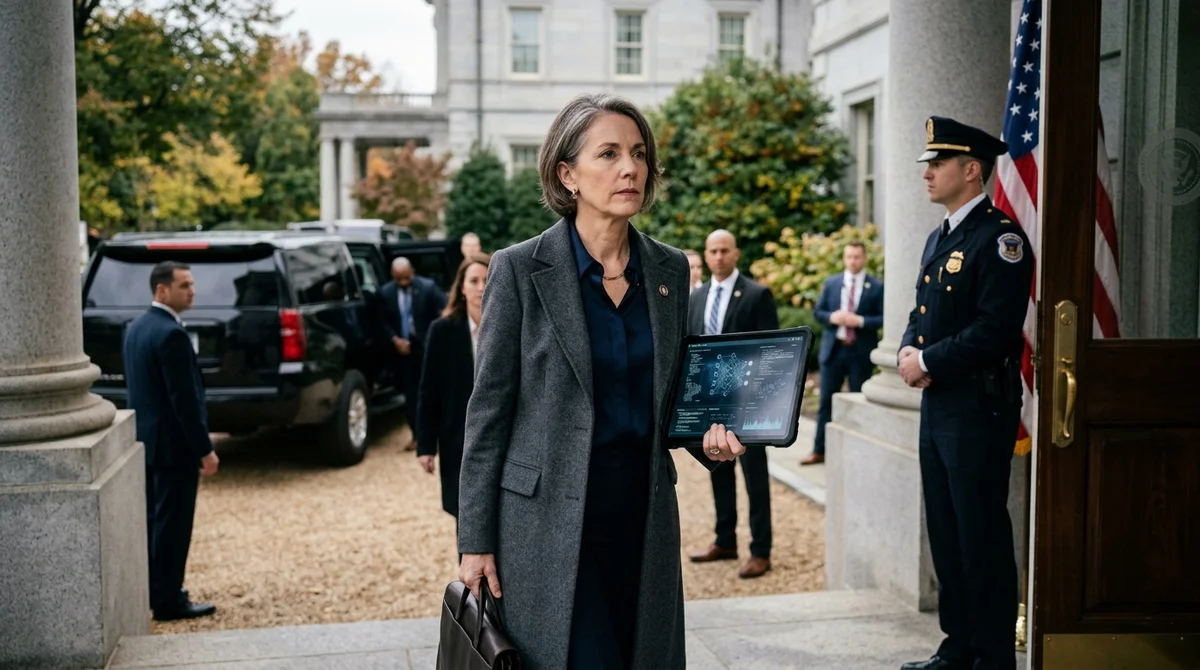
Anthropic is going straight to the White House at a moment when state access to frontier AI models has stopped being a technical detail and become a political issue in its own right. CEO Dario Amodei is expected to meet White House chief of staff Susie Wiles, while Donald Trump's administration pushes for broader access by US government agencies to the new Mythos model. According to people familiar with the matter, the meeting is scheduled for Friday, April 17, 2026.
The format alone is significant. This is not a routine product discussion with an agency, nor a public conference, but a conversation at the level of the White House's closest political leadership. It shows how quickly leading AI developers are moving out of the category of private technology companies and into the circle of players with whom the state builds separate relationships on access, control and use of key systems. Not long ago, such discussions were mostly seen as part of procurement or industry lobbying. Now they are increasingly taking shape as an element of the state agenda.
The available information indicates that the White House wants to expand US government access to Mythos, Anthropic's new and, by description, powerful AI model. The report does not disclose which tasks the access is requested for, or in what form: full-scale deployment, pilot projects, separate licenses for agencies, or a narrower usage regime. It is also unclear which bodies within the federal government are the main drivers of the expansion.
Even without these details, it is clear that Mythos is being treated not as just another corporate AI service but as a tool of interest at the federal level. In such cases, what matters is not only the quality of the model but also the developer's readiness to operate in settings where requirements for reliability, access management and internal restrictions are noticeably higher than in the ordinary corporate market.
For Anthropic, this is potentially a strong strategic moment. The company gets a chance to establish itself not only as a commercial AI vendor but as a government partner in a sensitive area where technology, security and politics intersect. At the same time, that proximity raises the stakes.
The broader the government's access to the model, the more questions arise about vetting mechanisms, restrictions, responsibility for the system's outputs, data protection, and who exactly inside the government will be able to use such tools. When a discussion reaches the level of the White House chief of staff, it usually means the issue is no longer only about the model's capabilities but about trust in the company as a supplier of infrastructure-critical technology. For Anthropic, this can open new opportunities, but also closer scrutiny of procedures, terms of use and the political consequences of every step.
There is another layer to the story: competition in the frontier AI market is shifting from user-facing features alone to the institutional standing of the developer. For leading labs, it is no longer enough to show a strong model; they also need to embed themselves in a system of relations with the state, especially in the US, where AI is increasingly tied to governance, national priorities and the regulatory agenda. If the government is pressing for broader access specifically to Mythos, the contest is no longer only for corporate customers and developers but also for positions inside the government perimeter.
By this logic, the winner is not necessarily whoever talks loudest about AI capabilities, but whoever can offer a model acceptable for sensitive use cases.
The main takeaway is that frontier AI models are finally becoming the subject of direct negotiations at the highest political level. For Anthropic, the meeting could be an important step toward strengthening its influence in Washington. For the market as a whole, it is a signal: simply releasing a strong product will not be enough for AI leaders. The ability to provide controlled access, political acceptability and the state's trust matters more and more.
- Nov 2, 2026Karpathy builds a YouTube clone with 6454 videos from Hacker News recommendations in two hours
- Nov 2, 2026Karpathy used Claude to build HackerTube from 6,454 videos recommended on Hacker News
- Nov 2, 2026Arca gives AI agents finance tasks lasting up to 10 days, but leaves the trades to humans
- Nov 2, 2026Anthropic needs to grow revenue 32% a year to cover $850 billion in contracts
Ship AI Faster with Founders, Engineers & Weekly Architecture Reviews
Inside Vibe Club (hamidun.com/club) — weekly live masterminds with Zhemal Khamidun, Tech Radar, full LMS access, and 370+ production Claude Code skills.
The AI world, distilled — once a week
Seven stories that actually mattered, hand-picked. No noise, no reposts, no press releases.
Done! Check your inbox for a confirmation.