Anthropic wants to widen access to Mythos, but the White House is stalling a plan for 120 organizations
Anthropic plans to expand access to Mythos, its closed model for finding and exploiting vulnerabilities, from roughly 50 to 120 organizations. The White House objects: officials worry such a tool could end up in the wrong hands, and that the company lacks the compute to serve even priority government tasks. A recent investigation into possible unauthorized access makes the dispute especially sharp.
AI-processed from 3DNews AI; edited by Hamidun News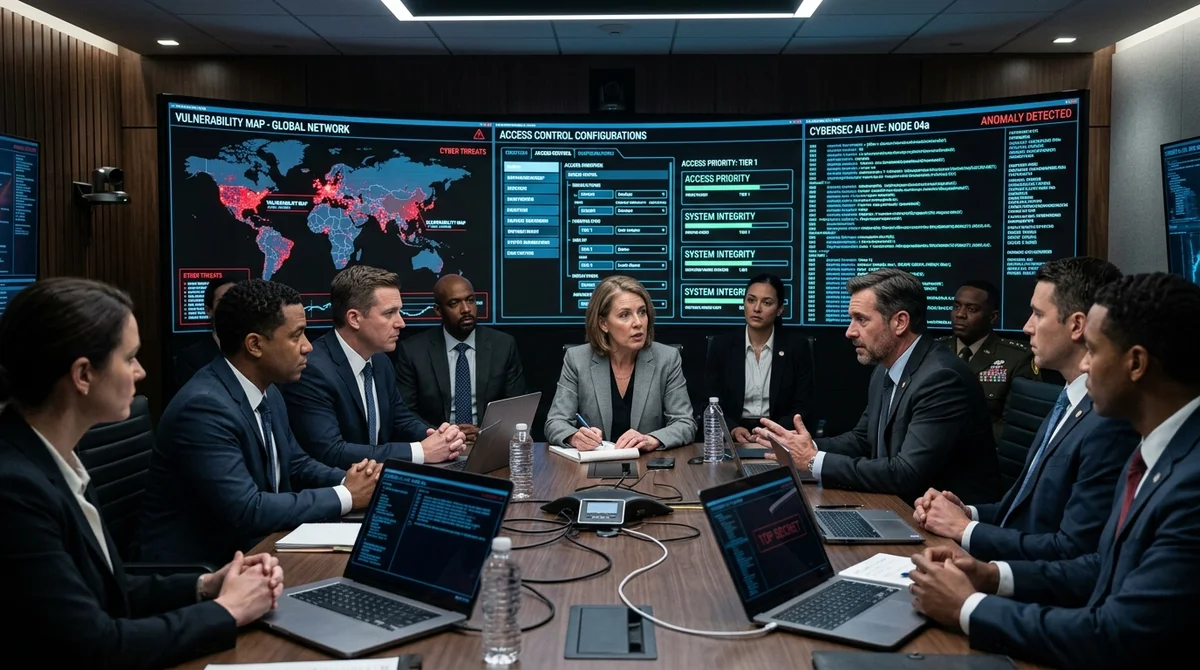
On April 30, 2026, Anthropic ran into resistance from the White House over its plans to expand access to Mythos, a closed AI model for finding and exploiting vulnerabilities. The company wants to grow its user base from roughly 50 to 120 organizations, but Washington believes the move could create new risks before it delivers benefits.
Why the dispute began
Mythos is not an ordinary chatbot, nor just another code-generation model. Anthropic positions it as a defensive cybersecurity tool: partners get access to test their own systems, find critical holes and patch them before attackers can exploit them.
The model is currently distributed under tight restrictions through Project Glasswing, and its first participants include large technology companies, infrastructure players and government bodies. Now the company wants to add about 70 more companies and organizations.
The logic is clear enough: the more large infrastructure owners check their products in advance, the less likely it is that vulnerabilities later turn into mass attacks. The White House sees it differently: if a model can not only find bugs but also suggest ways to exploit them, scaling up access becomes a political and national issue in its own right.
Why Mythos is considered dangerous
The authorities' concerns are not about the Anthropic brand but about the class of capabilities Mythos represents. In the official description of Project Glasswing, the company states plainly that the model has already found thousands of serious vulnerabilities, including flaws in major operating systems and browsers, and that it built some exploits almost autonomously. For defenders that is a powerful accelerator, but in the wrong hands the same mechanism could become a tool for attack, reconnaissance and pressure on critical infrastructure.
- By Anthropic's own assessment, Mythos outperforms almost all humans except the very strongest specialists at finding and exploiting vulnerabilities.
- The model is already used in a restricted environment and is not being prepared for a broad public release.
- The company itself admits that releasing such a tool without additional safeguards is still too risky.
- Last week, reports of possible unauthorized access to Mythos surfaced, and Anthropic opened an investigation.
Hence Washington's nervousness. The administration fears a scenario in which access expands faster than adequate safeguards are built. For the White House this is not an abstract debate about AI safety: the software in question is used in banks, clouds, government agencies, browsers and other core digital infrastructure. A mistake in managing such a tool can be costly even without a full leak of the model. And if similar capabilities eventually reach malicious actors, the price of delay or error rises further.
What is holding up the expansion
The White House has at least two concrete objections.
The first is the risk of abuse. Even if Anthropic vets participants manually, raising the number of organizations by almost two and a half times enlarges the attack surface: more accounts, integrations, employees and contractors.
The second is a shortage of computing capacity. Officials worry that if Anthropic sharply widens its user base, the company's capacity may fall short, and government agencies could lose priority access or face degraded service.
This dispute is not happening in a vacuum. Anthropic's relations with US authorities were already strained after a recent conflict over the terms of use of its models for the Pentagon. Against that backdrop, any new issue where frontier AI, cyberweapons and government priority intersect automatically goes beyond an ordinary product decision.
For Anthropic, expanding access looks like a step toward a larger-scale defense of the internet. For the White House, it looks like the risk of opening up a tool that is too powerful before control rules have been worked out.
What it means
The Mythos story shows that the next big AI dispute is no longer about text, images and office automation, but about the cyber capabilities of models. The more useful such systems are for defense, the more dangerous it is to scale them prematurely.
So access to advanced security models will most likely be determined for a long time not by the market but by negotiations among labs, large corporations and the state. And it is these disputes that will set the rules for the next generation of high-risk AI tools.
- Nov 2, 2026Karpathy builds a YouTube clone with 6454 videos from Hacker News recommendations in two hours
- Nov 2, 2026Karpathy used Claude to build HackerTube from 6,454 videos recommended on Hacker News
- Nov 2, 2026Arca gives AI agents finance tasks lasting up to 10 days, but leaves the trades to humans
- Nov 2, 2026Anthropic needs to grow revenue 32% a year to cover $850 billion in contracts
Key Questions Answered
Why the dispute began?
Mythos is not an ordinary chatbot, nor just another code-generation model. Anthropic positions it as a defensive cybersecurity tool: partners get access to test their own systems, find critical holes and patch them before attackers can exploit them. The model is currently distributed under tight restrictions through Project Glasswing, and its first participants include large technology companies, infrastructure players and government bodies. Now the company wants to add about 70 more companies and organizations. The logic is clear enough: the more large infrastructure owner
Why Mythos is considered dangerous?
The authorities' concerns are not about the Anthropic brand but about the class of capabilities Mythos represents. In the official description of Project Glasswing, the company states plainly that the model has already found thousands of serious vulnerabilities, including flaws in major operating systems and browsers, and that it built some exploits almost autonomously. For defenders that is a powerful accelerator, but in the wrong hands the same mechanism could become a tool for attack, reconnaissance and pressure on critical infrastructure. By Anthropic's own assessment,
What is holding up the expansion?
The White House has at least two concrete objections. The first is the risk of abuse. Even if Anthropic vets participants manually, raising the number of organizations by almost two and a half times enlarges the attack surface: more accounts, integrations, employees and contractors. The second is a shortage of computing capacity. Officials worry that if Anthropic sharply widens its user base, the company's capacity may fall short, and government agencies could lose priority access or face degraded service. This dispute is not happening in a vacuum. Anthropic's relations wit
Test Frontier LLMs & Autonomous Agents in One Workspace
Run Claude Opus 5.5, GPT-6, Gemini 3.1, and DeepSeek side-by-side in Nomad AI (nomadnet.ai) — unified model routing, deep research, and multimodal workflows under one subscription.
The AI world, distilled — once a week
Seven stories that actually mattered, hand-picked. No noise, no reposts, no press releases.
Done! Check your inbox for a confirmation.