White House opposes wider access to Anthropic's Mythos model
The White House has come out against Anthropic's plans to expand access to its Mythos model, according to the Wall Street Journal. The situation is unusual: the company itself believes the system is powerful enough to help carry out dangerous cyberattacks. That moves the dispute over the release out of the realm of competition and into national security. For the market, it is a signal that authorities will look not only at AI quality but also at access regimes, risk audits and misuse scenarios.
AI-processed from Bloomberg Tech; edited by Hamidun News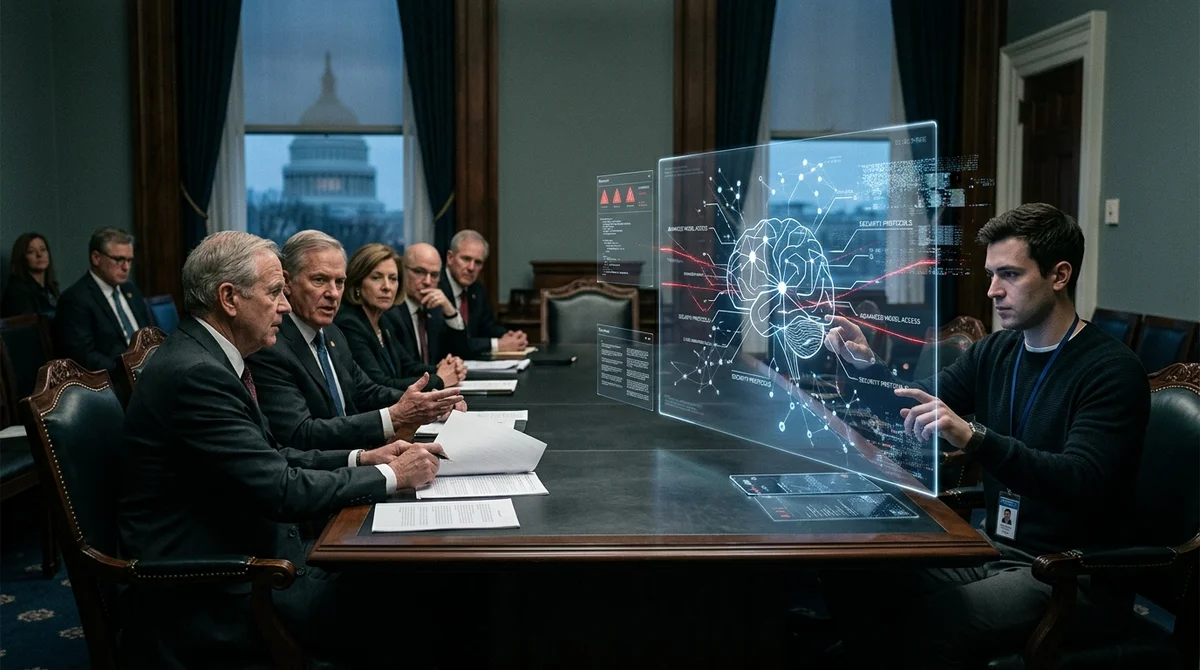
The White House has come out against Anthropic's plan to expand access to its Mythos model. According to The Wall Street Journal, the US administration did not back wider distribution of a system that the company itself considers powerful enough to facilitate dangerous cyberattacks.
What the conflict is about
Little is publicly known so far: Anthropic wanted to expand access to Mythos, and the White House, as WSJ writes, opposed the move. It is unclear whether this concerns a full commercial launch, access for new enterprise customers, or a loosening of current restrictions. But the political objection itself matters: the question of who gets access to the most powerful AI models, and on what terms, is now decided not only inside companies and not only by the market.
Another point stands out. This is not a model for generating images or everyday text, but a system that, by Anthropic's own assessment, may be powerful enough to assist dangerous cyberattacks. When a developer itself acknowledges that level of risk, the dispute over access stops being an ordinary debate about competition, release speed and user convenience. It becomes a question of national security and digital resilience.
Why this is alarming
Models with advanced cyber capabilities cause particular concern among authorities because they could lower the barrier to entry for attackers and speed up the work of groups that are already well prepared. Even if AI does not fully replace an experienced specialist, it can sharply cut the time needed for individual stages of an attack and scale up actions that previously required noticeably more manual work.
- Find and analyze vulnerabilities in code and infrastructure faster
- Generate or refine malicious scripts for a specific target
- Automate phishing campaigns and social engineering
- Suggest possible ways to bypass security mechanisms
- Speed up analysis of public data about companies and their systems
These risks do not mean that Mythos is already being used in such scenarios, or that Anthropic planned to release it without safeguards. But they explain why access to such systems is becoming a political issue. If the main arguments in AI used to be answer quality, token prices and the race for users, the focus now is on danger assessments, access regimes and the potential damage from improper distribution of the technology.
What changes for the market
The Mythos case shows that for developers of frontier models, an internal safety policy alone is no longer enough. Even if a company runs tests, imposes restrictions and describes the risks, that may not suffice for broader access if the state considers the threat too high. For the industry, this is a signal: the most powerful models, especially those tied to biosecurity, cyber risk or critical infrastructure, will increasingly face outside pressure before a mass release.
For Anthropic, this means a possible delay to its plans to scale Mythos, or the need to offer a stricter control regime. For other players, it is a reminder that the race between shipping speed and safety is entering a new phase. Companies will likely have to prove not only a model's usefulness but also that its worst-case scenarios are manageable: who gets access, what restrictions apply, how misuse is tracked, and whether access can be shut off quickly after an incident.
What this means
The dispute over Mythos shows that the era of abstract talk about AI regulation is ending. For the most powerful systems, access itself becomes a matter of political approval, and safety is not an add-on feature but a condition of launch.
- Nov 2, 2026Karpathy builds a YouTube clone with 6454 videos from Hacker News recommendations in two hours
- Nov 2, 2026Karpathy used Claude to build HackerTube from 6,454 videos recommended on Hacker News
- Nov 2, 2026Arca gives AI agents finance tasks lasting up to 10 days, but leaves the trades to humans
- Nov 2, 2026Anthropic needs to grow revenue 32% a year to cover $850 billion in contracts
Key Questions Answered
What the conflict is about?
Little is publicly known so far: Anthropic wanted to expand access to Mythos, and the White House, as WSJ writes, opposed the move. It is unclear whether this concerns a full commercial launch, access for new enterprise customers, or a loosening of current restrictions. But the political objection itself matters: the question of who gets access to the most powerful AI models, and on what terms, is now decided not only inside companies and not only by the market. Another point stands out. This is not a model for generating images or everyday text, but a system that, by Anthr
Why this is alarming?
Models with advanced cyber capabilities cause particular concern among authorities because they could lower the barrier to entry for attackers and speed up the work of groups that are already well prepared. Even if AI does not fully replace an experienced specialist, it can sharply cut the time needed for individual stages of an attack and scale up actions that previously required noticeably more manual work. Find and analyze vulnerabilities in code and infrastructure faster Generate or refine malicious scripts for a specific target Automate phishing campaigns and social en
What changes for the market?
The Mythos case shows that for developers of frontier models, an internal safety policy alone is no longer enough. Even if a company runs tests, imposes restrictions and describes the risks, that may not suffice for broader access if the state considers the threat too high. For the industry, this is a signal: the most powerful models, especially those tied to biosecurity, cyber risk or critical infrastructure, will increasingly face outside pressure before a mass release. For Anthropic, this means a possible delay to its plans to scale Mythos, or the need to offer a stricte
Test Frontier LLMs & Autonomous Agents in One Workspace
Run Claude Opus 5.5, GPT-6, Gemini 3.1, and DeepSeek side-by-side in Nomad AI (nomadnet.ai) — unified model routing, deep research, and multimodal workflows under one subscription.
The AI world, distilled — once a week
Seven stories that actually mattered, hand-picked. No noise, no reposts, no press releases.
Done! Check your inbox for a confirmation.