Taylor Swift moves to protect her image and voice after wave of TikTok deepfake scam ads
Taylor Swift's new trademark filings did not come out of nowhere: researchers found sponsored deepfake ads on TikTok featuring her, Rihanna and other celebrities. The videos promise easy money for watching content, then send users to third-party pages with forms that harvest personal data. The case shows how quickly deepfakes have become a tool of ordinary online fraud.
AI-processed from Wired; edited by Hamidun News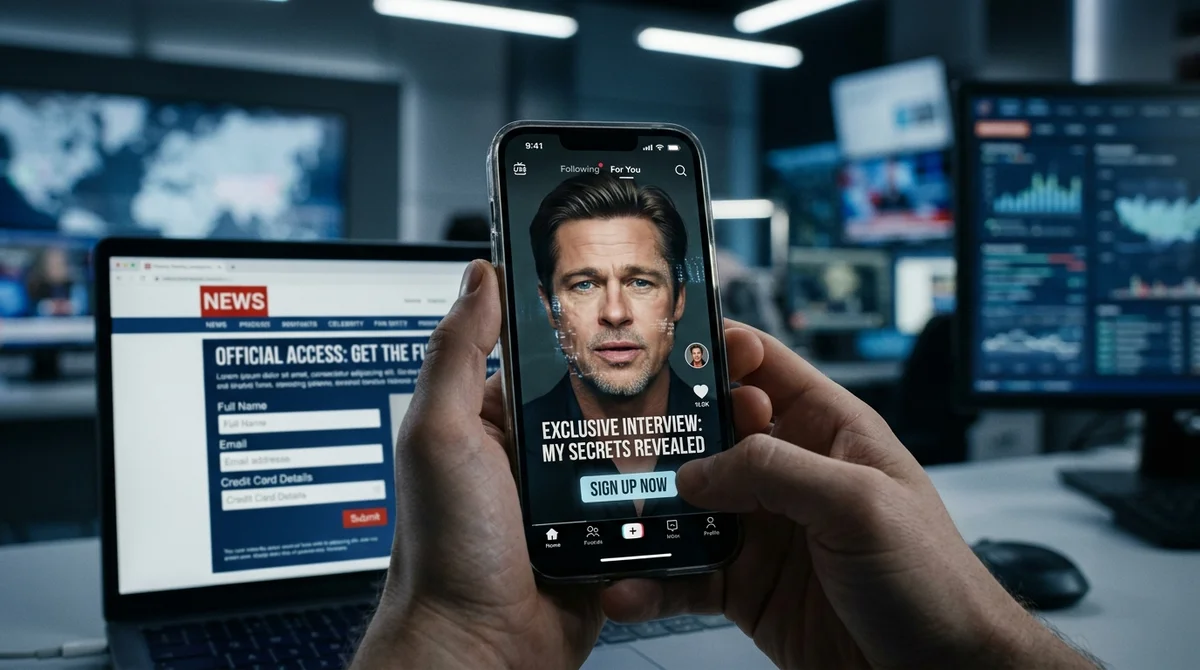
On April 24, Taylor Swift filed three trademark applications to protect her image and voice from AI fakes. The motive looks quite practical: researchers found a wave of deepfake ads on TikTok in which celebrities persuade users to reveal personal data.
How the scheme works
According to Copyleaks, scammers take real clips from interviews, red-carpet appearances and TV shows, then alter the video and audio so that Taylor Swift, Rihanna or Kim Kardashian appear to personally promote a new way to earn money inside TikTok. The videos use synthetic voices and visual filters that smooth over generation artifacts. Because the context is familiar — a studio, a microphone, a host, a recognizable camera angle — the fake does not look like a crude edit but like an ordinary clip from a media interview.
"If the page opened for you, don't think too long."
One example is a fake Swift talking about a TikTok Pay feature and inviting viewers to check whether they are eligible for the program. After the click, the user lands not on TikTok but on a third-party page with the platform's logos and a form asking for a name and other personal information. The researchers also note that these landing pages looked hastily assembled, and that some URLs and interface elements pointed to Lovable, a service for quickly building web pages.
Why celebrities are the target
Celebrity faces are used here for trust, not for reach. Users see a familiar person in a familiar setting and instinctively lower their skepticism. The Copyleaks case involves not only Swift but also Rihanna, Kim Kardashian and other celebrities. This is not a fan meme but sponsored advertising, meaning the videos were promoted by the platform's own algorithms and could reach a wide audience as ordinary promos.
- a real source interview instead of a fully generated scene
- an AI voice clone with familiar intonation
- filters and compression that hide video flaws
- TikTok branding on the landing page
- a promise of an easy reward for a simple action
Against this backdrop, Swift's move looks defensive rather than symbolic. The singer filed three applications: one for an image from the Eras Tour concert and two for short voice identifiers — "Hey, it's Taylor Swift" and "Hey, it's Taylor." Formally this is about brand protection, but in practice it is an attempt to gain extra legal tools against fake ads using her face and against AI copies, which are now made faster, cheaper and in bulk.
The problem is bigger than TikTok
The story is not limited to one singer or one platform. The scheme fits into a broader market of scam advertising on social media. This week the FTC reported that losses from fraud that began on social media reached $2.1 billion in 2025. People most often ran into fake stores and investment schemes, and social networks became a convenient entry point for deception: a familiar interface, targeting, and the sense that you are looking at just another ordinary ad.
In parallel, the first legal consequences of AI fakes are emerging in the US: in April, the first sentence was recorded under the new federal law against "intimate" visual deepfakes. But the Swift case shows a different side of the problem — not sexualized content, but commercial fraud and data harvesting disguised as celebrity endorsements. For platforms this is an uncomfortable signal: even if moderation can catch explicit disinformation, videos with fake endorsements at the intersection of advertising, phishing and generative video get through noticeably better.
What this means
Deepfakes have finally moved out of the viral-meme category and become a working tool of social engineering. Where the risk for celebrities was once measured in reputation, it is now directly tied to phishing, data theft and the legal protection of a digital identity.
- Nov 2, 2026The Verge reviewer builds a $50 Meta Muse Charm alternative with Claude Code
- Nov 2, 20268 Skills for video in Claude Code: from 244 pixel effects to rough-cut editing
- Nov 1, 2026Pika Labs releases open video model H3 Flex: 6 steps instead of 50
- Nov 1, 2026Google's StreamVibe video agent beats other models by 10.7% on response timing and quality
Key Questions Answered
How the scheme works?
According to Copyleaks, scammers take real clips from interviews, red-carpet appearances and TV shows, then alter the video and audio so that Taylor Swift, Rihanna or Kim Kardashian appear to personally promote a new way to earn money inside TikTok. The videos use synthetic voices and visual filters that smooth over generation artifacts. Because the context is familiar — a studio, a microphone, a host, a recognizable camera angle — the fake does not look like a crude edit but like an ordinary clip from a media interview. "If the page opened for you, don't think too long." O
Why celebrities are the target?
Celebrity faces are used here for trust, not for reach. Users see a familiar person in a familiar setting and instinctively lower their skepticism. The Copyleaks case involves not only Swift but also Rihanna, Kim Kardashian and other celebrities. This is not a fan meme but sponsored advertising, meaning the videos were promoted by the platform's own algorithms and could reach a wide audience as ordinary promos. a real source interview instead of a fully generated scene an AI voice clone with familiar intonation filters and compression that hide video flaws TikTok branding o
What are the key details on The problem is bigger than TikTok?
The story is not limited to one singer or one platform. The scheme fits into a broader market of scam advertising on social media. This week the FTC reported that losses from fraud that began on social media reached $2.1 billion in 2025. People most often ran into fake stores and investment schemes, and social networks became a convenient entry point for deception: a familiar interface, targeting, and the sense that you are looking at just another ordinary ad. In parallel, the first legal consequences of AI fakes are emerging in the US: in April, the first sentence was reco
Test Frontier LLMs & Autonomous Agents in One Workspace
Run Claude Opus 5.5, GPT-6, Gemini 3.1, and DeepSeek side-by-side in Nomad AI (nomadnet.ai) — unified model routing, deep research, and multimodal workflows under one subscription.
The AI world, distilled — once a week
Seven stories that actually mattered, hand-picked. No noise, no reposts, no press releases.
Done! Check your inbox for a confirmation.