Google makes switching to Gemini easier: you can now import memory, chat history and settings
Google has made it easier for users of other AI services to switch to Gemini. You can now import your memory, conversation history and personal settings, so there is no need to train a new assistant from zero. This matters most to people who have already built workflows in ChatGPT or similar products: changing services no longer means losing familiar context, response style and accumulated preferences.
AI-processed from ZDNet AI; edited by Hamidun News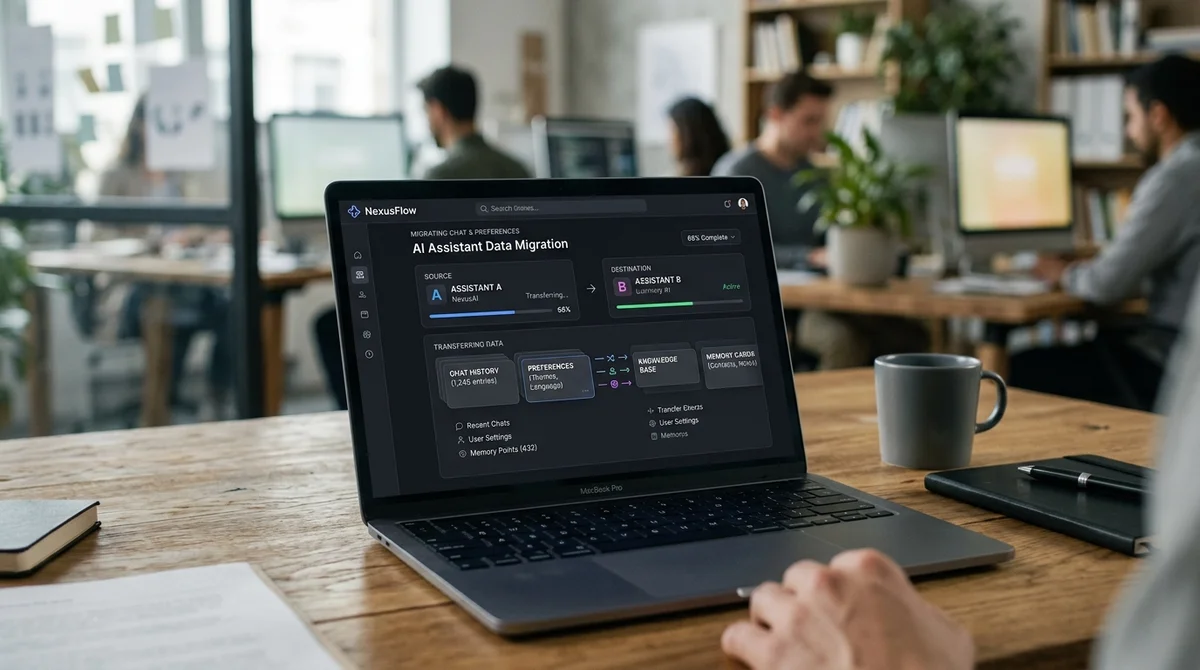
Google has added a feature to Gemini that imports data from other AI services. Users can now bring saved memory, conversation history and personal settings into the new chatbot instead of starting from scratch.
What gets transferred
The idea behind the update is simple: Gemini is trying to remove the most annoying barrier to switching AI assistants, the loss of accumulated context. For active users, that context builds up over months: a preferred response style, work topics, recurring tasks, biographical details and chains of past conversations. When all of it stays in another service, even a good new product feels empty. Google now offers to move this layer of context into Gemini without rebuilding your habits by hand.
- Memory — facts about the user and their long-term preferences
- Chat history — past conversations that can inform new requests
- Settings — response format, tone of communication and other personal parameters
- Work context — topics and scenarios the user returns to regularly
In essence, Gemini wants to greet a new user not as a blank slate but as an assistant that already understands the basic expectations. This matters most to people who use AI daily rather than occasionally: for work, study, writing text, researching topics or running projects. The more of those accumulated habits can be preserved, the fewer reasons there are to put off switching or to stay with an old service out of inertia alone.
Why it matters
Until now, competition between AI assistants has often come down not only to model quality but also to switching costs. In theory, changing services is easy: open a new site, sign up, write a first prompt. In practice, you have to explain all over again to the assistant how you like to work, what tasks you handle, what constraints to respect and what style to answer in. It is not one click but a hidden week of adaptation.
Gemini's new feature targets exactly this problem. For Google, it is also a clear way to ease migration from rival ecosystems, above all ChatGPT, which is named explicitly in the headline of the original material. Instead of the abstract pitch "try our AI," the company offers a stronger argument: "come with your accumulated experience." That logic can work better than any comparison table, because it reduces not a theoretical risk but a very everyday one: losing your familiar working rhythm.
How the market is changing
This move shows that the generative AI market is gradually maturing. Where services once competed mainly on context window size, speed and answer quality, portability of user experience is now becoming important too. Memory, history and settings are turning into an asset that users expect to control themselves. The more valuable that asset becomes, the stronger the demand that it be portable between platforms as easily as contacts or photos.
If such transfer really works reliably, it may change audience behavior. People will be more willing to test new tools because the cost of an experiment drops. And AI product developers will have to compete not only for initial acquisition but also for retention of an already "trained" user. Put simply, model quality will remain important, but quality alone will be harder to use to keep an audience.
What this means
Google is betting not just on a new Gemini feature but on lowering the cost of switching between AI services. For users, it is a chance to change assistants without losing accumulated context. For the market, it is a signal that the fight is no longer only about model power but also about the right to be the most convenient place for everyday work with AI.
- Nov 2, 2026Karpathy builds a YouTube clone with 6454 videos from Hacker News recommendations in two hours
- Nov 2, 2026Karpathy used Claude to build HackerTube from 6,454 videos recommended on Hacker News
- Nov 2, 2026Anthropic needs to grow revenue 32% a year to cover $850 billion in contracts
- Nov 2, 2026Bun creator uses Claude Code to port 750K lines from Zig to Rust in 11 days
Key Questions Answered
What gets transferred?
The idea behind the update is simple: Gemini is trying to remove the most annoying barrier to switching AI assistants, the loss of accumulated context. For active users, that context builds up over months: a preferred response style, work topics, recurring tasks, biographical details and chains of past conversations. When all of it stays in another service, even a good new product feels empty. Google now offers to move this layer of context into Gemini without rebuilding your habits by hand. Memory — facts about the user and their long-term preferences Chat history — past c
Why it matters?
Until now, competition between AI assistants has often come down not only to model quality but also to switching costs. In theory, changing services is easy: open a new site, sign up, write a first prompt. In practice, you have to explain all over again to the assistant how you like to work, what tasks you handle, what constraints to respect and what style to answer in. It is not one click but a hidden week of adaptation. Gemini's new feature targets exactly this problem. For Google, it is also a clear way to ease migration from rival ecosystems, above all ChatGPT, which is
How the market is changing?
This move shows that the generative AI market is gradually maturing. Where services once competed mainly on context window size, speed and answer quality, portability of user experience is now becoming important too. Memory, history and settings are turning into an asset that users expect to control themselves. The more valuable that asset becomes, the stronger the demand that it be portable between platforms as easily as contacts or photos. If such transfer really works reliably, it may change audience behavior. People will be more willing to test new tools because the cos
Test Frontier LLMs & Autonomous Agents in One Workspace
Run Claude Opus 5.5, GPT-6, Gemini 3.1, and DeepSeek side-by-side in Nomad AI (nomadnet.ai) — unified model routing, deep research, and multimodal workflows under one subscription.
The AI world, distilled — once a week
Seven stories that actually mattered, hand-picked. No noise, no reposts, no press releases.
Done! Check your inbox for a confirmation.