Google makes switching to Gemini easier with chat history import from ChatGPT and Claude
Google has released a tool for Gemini that lets users upload chat history and context from other AI apps. The idea is simple: people don't start from scratch after switching, and can bring their accumulated background over from ChatGPT or Claude. For the market, it's an important signal. Competition is no longer only about model quality, but also about winning over rivals' audiences along with their memory.
AI-processed from Bloomberg Tech; edited by Hamidun News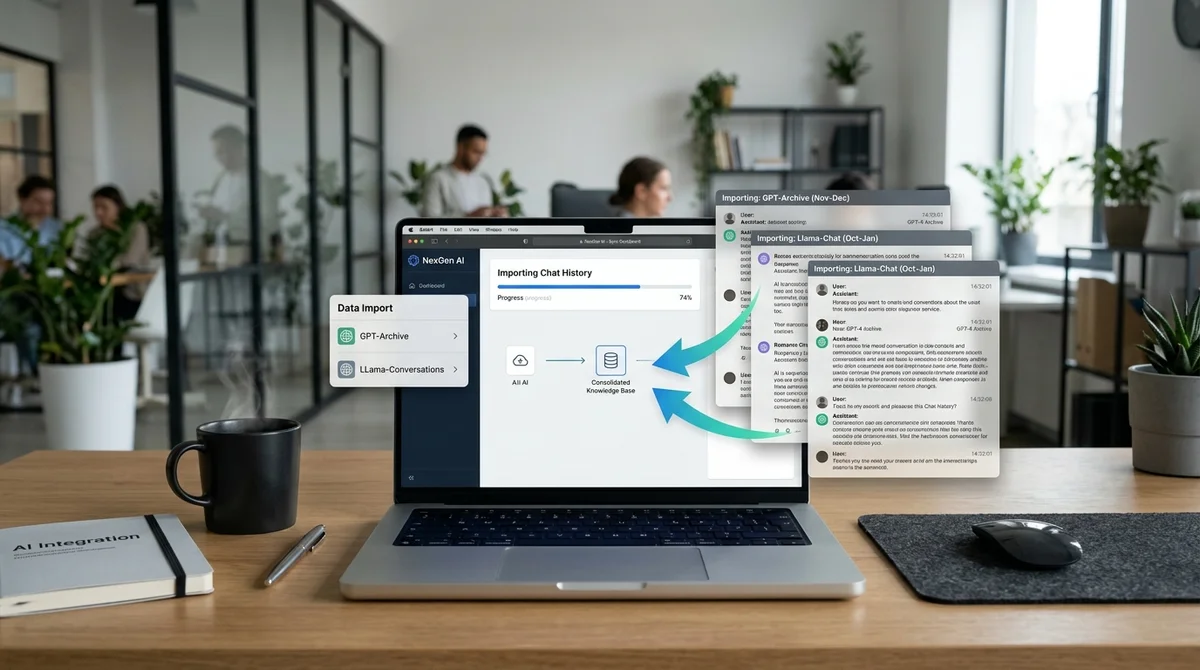
Google has released new migration tools for Gemini that let users upload chat history and context from other AI apps. The company is clearly targeting one of the strongest barriers in the AI assistant market: users' reluctance to lose their accumulated conversational experience when switching services.
Why Google is doing this
The AI assistant market is maturing fast, and the fight is now about ease of entry as well as model quality. Many users already live inside a single chatbot: dozens of threads, work notes, custom instructions, drafts and long chains of questions. Moving to another assistant is hard, both psychologically and practically, even if it is stronger at some tasks. Google is trying to remove exactly this barrier and make starting out in Gemini less painful.
This matters especially for Google because it is competing with entrenched players. The company is clearly aiming at the audiences of ChatGPT and Claude, services with strong user habits and large volumes of accumulated conversations. If people can bring their context from another app into Gemini, the decision to try a new product gets easier. It is no longer a "start over" scenario but a "come in with what you already have" scenario.
How the transfer works
According to Google's description, Gemini will now be able to accept uploaded chat history and context from other AI apps. This does not look like a merely cosmetic feature. In effect, import becomes part of onboarding: the user arrives not at an empty window but in an environment where they can immediately continue working with their previous background, topics and the logic of past conversations. For people who use AI every day, this can matter more than yet another abstract gain on a benchmark.
- Carries accumulated context over to the new service
- Reduces the need to rebuild old conversations by hand
- Makes side-by-side comparison of different models easier
- Removes some of the fear of losing work history when changing assistants
The move addresses a problem that has long been underestimated: in modern chatbots, value comes not only from the model itself but also from the user's memory inside the product. The more old conversations, templates and familiar workflows someone has, the higher the cost of leaving. If import really works smoothly, Google has a chance to attack not only rivals' technological lead but also their hidden defense: the accumulated user archive.
The fight for habit
In 2026, competition between AI assistants is shifting more and more from "who is smarter" to "who is more convenient in everyday work." Many users already have a main bot for writing, analysis, code or research. But that lead rests on more than answer quality. It rests on habit: the bot already knows the user's prompting style, project history, preferred answer format and a set of old discussions to return to.
An import tool hits exactly this advantage. For professional users and teams, the change may be especially sensitive. When a service holds months of work discussions, migration becomes a project of its own, and testing alternatives gets postponed. The ability to upload history and context makes Gemini a more realistic option, not only for curious early adopters but also for those who have stayed with ChatGPT or Claude simply because everything is already set up there. In other words, Google is lowering the price of experimenting.
What it means
Google is showing that the next big battle in the AI market is over the portability of accumulated experience. If users can move their history between assistants without pain, the market will become less closed: people will more often keep several tools at once and pick the best one for a given task. For Gemini, this is a chance to grow not only through new users but also by drawing in those who are deeply rooted in competitors' ecosystems.
- Nov 2, 2026Arca gives AI agents finance tasks lasting up to 10 days, but leaves the trades to humans
- Nov 2, 2026Meta's Muse assistant keeps dossiers on loved ones and gets root on Ubuntu by default
- Nov 1, 2026Local models lose to Opus and Codex: 0.21 on a MacBook versus 1.00 for Codex
- Nov 1, 2026Kimi scores 96.2% on a 1C database analytics test and emerges as a fallback if Claude access is blocked
Key Questions Answered
Why Google is doing this?
The AI assistant market is maturing fast, and the fight is now about ease of entry as well as model quality. Many users already live inside a single chatbot: dozens of threads, work notes, custom instructions, drafts and long chains of questions. Moving to another assistant is hard, both psychologically and practically, even if it is stronger at some tasks. Google is trying to remove exactly this barrier and make starting out in Gemini less painful. This matters especially for Google because it is competing with entrenched players. The company is clearly aiming at the audie
How the transfer works?
According to Google's description, Gemini will now be able to accept uploaded chat history and context from other AI apps. This does not look like a merely cosmetic feature. In effect, import becomes part of onboarding: the user arrives not at an empty window but in an environment where they can immediately continue working with their previous background, topics and the logic of past conversations. For people who use AI every day, this can matter more than yet another abstract gain on a benchmark. Carries accumulated context over to the new service Reduces the need to rebui
What are the key details on The fight for habit?
In 2026, competition between AI assistants is shifting more and more from "who is smarter" to "who is more convenient in everyday work." Many users already have a main bot for writing, analysis, code or research. But that lead rests on more than answer quality. It rests on habit: the bot already knows the user's prompting style, project history, preferred answer format and a set of old discussions to return to. An import tool hits exactly this advantage. For professional users and teams, the change may be especially sensitive. When a service holds months of work discussions
Test Frontier LLMs & Autonomous Agents in One Workspace
Run Claude Opus 5.5, GPT-6, Gemini 3.1, and DeepSeek side-by-side in Nomad AI (nomadnet.ai) — unified model routing, deep research, and multimodal workflows under one subscription.
The AI world, distilled — once a week
Seven stories that actually mattered, hand-picked. No noise, no reposts, no press releases.
Done! Check your inbox for a confirmation.