Nvidia cashes in: Big Tech earmarks $650 billion for hardware
Investors have bought into the magic of big numbers again: Nvidia shares jumped on news that the largest tech giants plan to spend $650 billion on AI infrastructure this year. Microsoft, Google and Meta are not just refreshing servers; they are laying the foundation for a new economy. For Nvidia, that means an endless stream of orders for Blackwell-architecture chips. The market is ignoring talk of overheating and following actual corporate budgets. Anyone who doubted the staying power of the AI trend should find that these figures clear the fog. This is the largest reallocation of capital in the industry's history, and the "green giant" remains its main beneficiary. *Meta has been designated an extremist organization and is banned in Russia.
AI-processed from Bloomberg Tech; edited by Hamidun News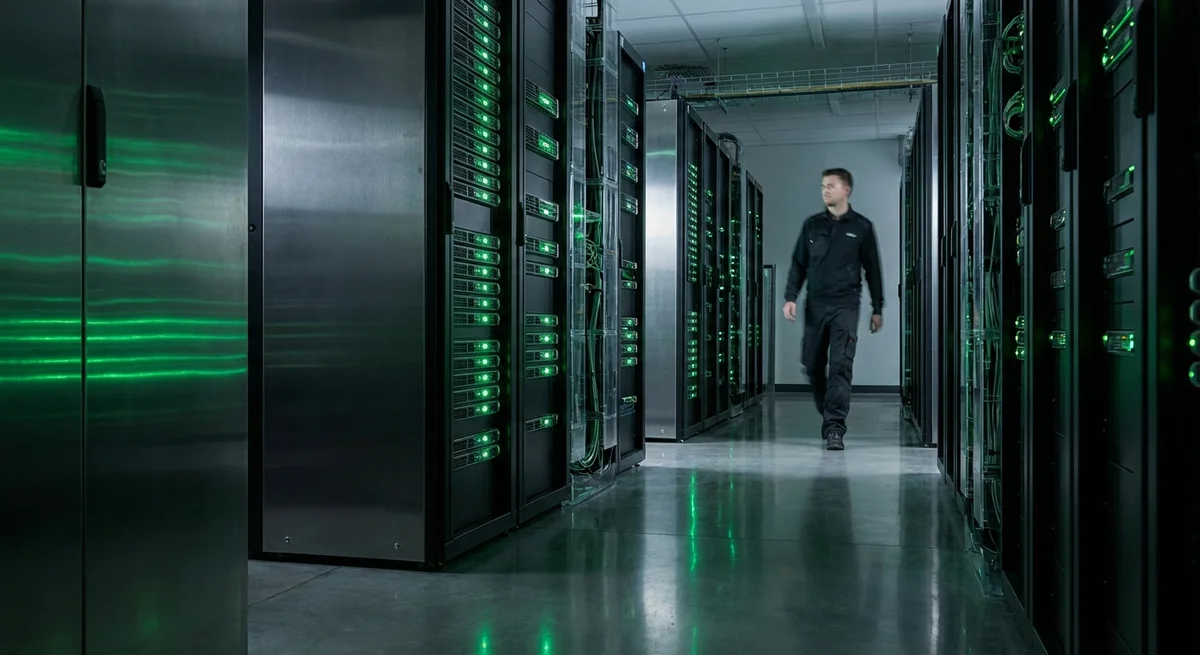
The stock market sometimes looks like a casino, but when $650 billion is on the table, it stops being a gamble and becomes a carefully calculated survival strategy. Nvidia shares are climbing again, and the reason is not another burst of chatbot hype but the dry pragmatism of Big Tech. Microsoft, Google, Amazon and Meta have effectively signed off on the idea that there is no way back. They are ready to spend astronomical sums on infrastructure, and most of that money will inevitably end up in Jensen Huang's pockets. This is not just investment; it is a large-scale rebuild of the global economy around the needs of neural networks.
Six months ago, many self-appointed prophets were predicting an imminent "hangover" after the explosive growth of 2023. They talked about chip overproduction, about software failing to keep pace with hardware capacity, and about a bubble about to burst. The latest reports from the tech giants showed exactly the opposite: capacity shortages are still being felt, and corporate appetites keep growing. This $650 billion is not just a line item in a server-upgrade budget. It is the price of admission to the club of companies that will shape technology for the next ten years. A company that does not invest in hardware today will simply be unable to launch a competitive next-generation model tomorrow.
Why now? Because the race has moved from "let's give it a try" to industrial-scale deployment. Training models like GPT-5 or new iterations of Gemini takes exponentially more compute than their predecessors. Nvidia plays the role of the only supplier of quality "shovels" during a gold rush. And these shovels are golden in their own right, with practically no real alternatives. While AMD tries to close the gap in the software ecosystem and cloud providers are still designing their custom chips, Nvidia is already gearing up to ship the new Blackwell architecture, which promises an even bigger performance lead.
It is interesting to watch investor rhetoric change. Where they once demanded immediate profit from putting AI into end products, they now seem to have accepted that you first have to build a huge "factory" and only then wait for output. These colossal capital expenditures (Capex) are a long-term bet. Corporations fear not that they will overspend, but that they will spend too little and lose the arms race. In that context, Nvidia is becoming more than a hardware maker; it is a kind of tax authority for the entire artificial intelligence industry. Want to build the future? Pay Nvidia's "tax" and queue up for GPUs.
For the industry as a whole, this is a strong signal of continuing consolidation. Smaller players will find it even harder to compete with giants that can afford purchases worth tens of billions of dollars. We are watching a new technological oligopoly take shape, in which compute becomes a hard currency like oil in the twentieth century or gold in the nineteenth. Whoever has more GPU clusters and a better-tuned CUDA ecosystem dictates the rules. And as long as this trend holds, Nvidia will stay at the top of the food chain, ignoring any talk of market bubbles and temporary corrections.
Of course, a reasonable question arises: what happens when all the data centers are finished and packed with chips to capacity? But that moment is still a long way off. Each new generation of large language models needs an order of magnitude more compute for training and inference, so the hardware refresh cycle will only speed up. We are entering an era in which software and hardware are bound together more tightly than ever. Nvidia is successfully exploiting that link, turning raw compute into the scarcest and most expensive resource on the planet. Investors understand this and keep voting with their dollars for the "green" monopoly.
The bottom line: $650 billion is a powerful shot of confidence for the whole sector. As long as Big Tech is willing to pay for the right to stay in the game, Nvidia will keep growing, and skeptics will have to find new arguments. The only question is when these investments will turn into real benefits for business beyond chip sales, but the market seems ready to wait as long as it takes.
*Meta has been designated an extremist organization and is banned in Russia.
- Nov 2, 2026Anthropic needs to grow revenue 32% a year to cover $850 billion in contracts
- Nov 2, 2026TensorFold 1.2.0 boosts Qwen3.8-27B throughput on M3 Ultra by 44.2% at 16 streams
- Nov 1, 2026Local models lose to Opus and Codex: 0.21 on a MacBook versus 1.00 for Codex
- Nov 1, 2026Habr author fine-tunes YOLOv8l on dental X-rays and pushes mAP50 to 0.642
Test Frontier LLMs & Autonomous Agents in One Workspace
Run Claude Opus 5.5, GPT-6, Gemini 3.1, and DeepSeek side-by-side in Nomad AI (nomadnet.ai) — unified model routing, deep research, and multimodal workflows under one subscription.
The AI world, distilled — once a week
Seven stories that actually mattered, hand-picked. No noise, no reposts, no press releases.
Done! Check your inbox for a confirmation.